Center for World Conflict and Peace

Center for World Conflict and Peace

Wednesday, January 7, 2015

#JeSuisCharlie

Embedded image permalink
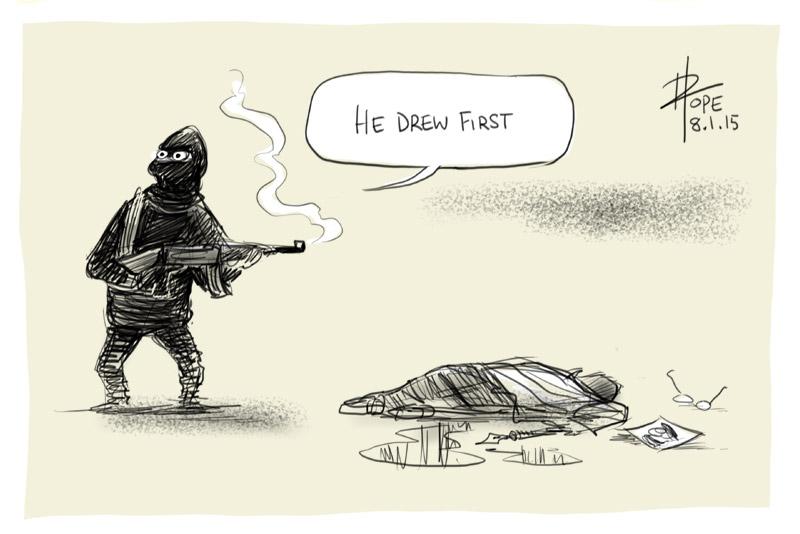
Cartoon by David Pope.

Earlier today three Islamic terrorists unleashed their fury at the personnel of Charlie Hebdo, an Onion-like French publication, gunning down 12 people, including two police officers. The main targets were the cartoonists at Charlie Hebdo who had drawn and published images of the so-called prophet Muhammad—a big no-no to radical Islamists, who have consistently over the last decade issued threats of violence, and on occasion committed violence against those who do so (including the 2011 firebombing of CH offices in 2011)—and have lampooned Islam more generally. After committing the heinous acts, the three assailants—eventually identified as Said Kouachi and Cherif Kouachi, both French, from Paris, and in their early 30s, and 18-year-old Hamyd Mourad, from Reims—escaped into a getaway car and were on the loose for hours. The latest report, according to Agence France-Presse, is that Mourad has surrendered to police; there are conflicting reports regarding the whereabouts of the other two terrorists.

Certainly, this was a sad day for the friends and families of the victims, for France, and for advocates of free speech and a liberal society worldwide. This attack was calculated and deliberate, not a haphazard or random act of violence. It was designed to assassinate people who freely wield the pen, who write or draw what they want—which is a hallmark of classical liberalism, as it is a key element of speaking truth to power structures, whether domestic or foreign. Of course, the killings weren’t only done to take out various Charlie Hebdo staff, but also to send a signal to other journalists—in France, in the West, around the globe—that they too are under threat if they don’t watch what they say about Islam. One of their goals is to place restraints on freedoms of speech by forcing journalists to self-censor their work, which shouldn’t be surprising.

After all, Islamic terrorists abhor freedom and democracy, believing they are human creations that place man, not God or Allah, at the center of politics and society. Since these terrorists don’t pose an existential threat to Western countries—yes, they can attack people and things, but can’t take over Western states and institutions—the next best thing is to hollow out Western institutions and ideals. Censorship—via foreign or domestic coercion—effectively enervates the foundations of liberal rights and freedoms, and by extension democracy itself as well.  

It is interesting that this incident comes so soon after the fiasco involving “The Interview.” Different actors, different methods, of course, but a similar goal by the perpetrators in both cases. The North Korean hackers sought revenge over the content of the movie, which was all about the assassination of Kim Jong Un, and tried to leverage influence over the public release of the movie. At first, Sony caved in, canceling the public release, then, in response to American outcry, placed the movie online and held a limited Christmas-day release. But Sony’s later moves weren’t enough to compensate for the millions of dollars likely lost as a result of its initial cancellation; moreover, they sent a chilling message to bad guys around the world that it’s indeed possible to leverage a veto, even if only temporary, over what the U.S. does. So In effect, then, the North Koreans were successful in effecting a form of censorship on the U.S.

Unfortunately, immediately after the attacks, reports surfaced that CNN and the Associated Press, taking their cues from Sony, were reluctant to show images of the cartoons that were deemed incendiary by Islamic radicals and terrorists. Sure, these media outlets need to exercise caution because the security of their employees could be in jeopardy, depending on the decisions they make. Yet, at the same time, they have a responsibility to tell the full story of the attacks, and a part of that story is the work of the cartoonists—not just a description of their work, but the images, pictures of the actual cartoons. In fact, by showing the the cartoonists’ work, media sources can actually celebrate their lives as well as their liberal ideals—the right to create, to stimulate discussion, to provoke, to critique. But by exercising a degree of self-censorship, CNN and the AP are caving into the terrorists’ interests and demands. Sounds trite, yes, but it’s also true. Why should we value the interests and values of terrorists over those who embrace and reflect the best of humanity?

On the positive side, many posters on Facebook and Twitter have showed images of Charlie Hebdo cartoons. It’s this kind of resilience and spirit that keeps liberal values alive and well, and both will be needed to continue to fight the spread of the virulent strain of Islamic radicalism that exists today.

Monday, December 22, 2014

2014 Person of the Year: Vladimir Putin


Maxim Zmeyev/Reuters

My choice for 2014 world politics Person of the Year is Vladimir Putin. Of course, my selection isn’t because he was a good guy. On the other hand, my choice of Putin isn’t solely because he was a bad guy, though, yes, that’s part of the story. Instead, I chose Putin because, in my view, he was the most newsworthy actor in world politics in 2014, both in terms of the importance of his actions and policies as well as the length of time they have dominated the news. Russia and IR watchers more generally have focused heaps of attention on him throughout the entire year. Just consider these series of events, all of which were orchestrated by Putin and his cabal, which stretch from February to December 2014: The Winter Olympics, Russia’s capture of Crimea, the unrest in Eastern Ukraine, the finalization of Putin’s planned Eurasian Economic Union, the collapse of the Russian Ruble.
Certainly, Putin’s most profound move was to create instability in Ukraine. Under his watch, Russia has effectively dismembered Ukraine. Russia has seized Crimea and played a huge part in fomenting a resistance in Eastern Ukraine, leaving Ukraine a shell of what it once was. Putin’s excellent adventures in Ukraine have created another Russian-made frozen conflict that has no end in sight. They patently violate international law and norms on sovereignty and self-determination. They potentially send a signal to other would-be aggressors, such as China, that conquest is permissible in world politics. They have also sent shivers throughout neighboring countries, such as Kazakhstan, which worry that they could be next on Putin’s hit list.
Russian actions in Ukraine were motivated by several factors, including Putin’s narcissism and ego and his quest to restore Russia as a major world power. Arguably, the most consequential factor has been Putin’s desire to show the Western powers, particularly the U.S., who the real boss is.
In Putin’s view, Russia has languished for the past two plus decades as a humiliated, defanged country, and the main culprit is America. Russia lost the cold war and lost it on American terms. After all, Germany unified and became a member of the Western camp, and the EU and NATO, because of U.S. hegemonic ambitions, has expanded into Central and Eastern Europe, the Soviets old stomping grounds. Throughout the 1990s and 2000s, Russia has had to suffer the indignity of seeing the U.S., as the sole dominant power, throw its weight around the world, starting wars around the world, even going so far as to use military bases of former Soviet states. More recently, the Western-led invasion of Libya exacerbated these feelings of humiliation: Russia never agreed to the ouster to Gaddafi, only to the assistance and protection of Libyans thought to be in harm’s way.
Prior to Putin’s shenanigans in the spring of 2014, decision-making calculus was shaped by his perception of Western resolve and credibility. Although those two terms are widely overused in policy and academic analysis, they are appropriate here. Putin saw the U.S. and its NATO partners as weak, reluctant to confront him head-on. Western criticisms of Russian behavior in Ukraine would remain in word only; the West would do little follow-up to punish Russia. As a result, because of few fears of external punishment, Putin believed there was little downside to challenging EU countries and the U.S. He also received a domestic benefit from asserting himself in Ukraine: challenging the Washington plays well internally in Russia, as it capitalizes on longstanding negative attitudes toward the U.S. and stimulates Russian nationalism.
The major narrative in the West, especially in the U.S., by the summer of 2014 was that Putin won the battle over Ukraine. American pundits were falling over themselves in lavishing praise on Putin. Putin was a strategic genius who boxed in the West, which was flummoxed to come up with a strong response to Russia’s moves. EU countries didn’t want to impose harsh sanctions on Russia, because they desperately need Russia for energy supplies. President Obama, knowing well that Ukraine isn’t an American national priority and having his hands full with turmoil and violence in the Middle East, wasn’t inclined to demonstrate much leadership on the matters there. The punchline was that the world simply had to accept the fact of a resurgent, aggressive Russia, led by a master-level strategic thinker and player.
Ah, but times have changed. At this point, the big question now is whether Putin has overplayed his hand. It’s very likely he has. The markets have responded to Russian aggression and they’re not happy. Money has been flying out of the country and the Russian Ruble is virtually worthless. Oil prices, which Putin relies on so much for his continued rule and muscle flexing, have fallen through the floor. But not only that, Putin, or his successors, must eventually come to grips with the idea that Ukraine will probably become a full-fledged member of the West. Putin has alienated many ethnic Ukrainians, who now no longer want to be under his thumb. And a significant number of ethnic Russian Ukrainians living in Crimea are now Russians, as a result of the land grab, which could prove to tip the balance once and for all in the ongoing debate over Ukraine’s future: lean West or East?

Saturday, December 20, 2014

Lessons from the North Korean Cyber Attack

In his 2010 book Cyber War, former US counter-terrorism czar Richard Clarke described some very scary potential results from a foreign cyber attack on US infrastructure. Cyber attacks have happened both on their own (such as alleged Chinese attacks on the Pentagon) as well as to complement a larger conventional war (such as Russian cyber attacks against Georgia during the war in August, 2008).  The recent cyber attack against Sony has been likened to stifling free speech. President Obama criticized Sony’s decision to cancel the movie, stating  "We cannot have a society in which some dictator someplace can start imposing censorship in the United States."

North Korea threatened to launch attacks against the US if The Interview were released, because of the supposed dishonor to the North Korean leader it would be. As a resident of South Korea, I was of course initially slightly worried- even though I had a pretty good idea that would not happen, I’m still enough of a greenhorn in this country to at least think for a second about it. Of course, North Korea was rather upset at the release of Team America in 2004 (a movie which I found to be quite hilarious as an immature, pubescent high schooler). It seems, however, they’ve managed to do that without firing a shot or a missile.

The US Department of Defense issued a report stating that while North Korea likely had some sort of cyber warfare capabilities, the impoverished nation was unlikely to have enough capabilities for a powerful, large-scale attack. Conversely, it would stand to reason that as company like Sony would have the latest and most state-of-the-art cyber security capabilities. People’s general conception of cyber war has centered on the notion of national militaries using cyber capabilities to attack each other. Other incidents such as the Target Corporation data breach were seen more as criminal acts rather than acts of war. Newt Gingrich has been quick to assert that the US “just lost its first cyber war” in a famous tweet. I’m not sure this was “our first cyber war”, but it is a very telling incident.

I have no way of knowing if it really and truly was North Korea that carried out the attack, and not some techie sitting in a remote cabin in the mountains of Washington state (yes, I know someone like that). But I have to assume that US authorities are correct in assigning blame to North Korea. In which case, there are several valuable lessons to be learned from this whole fiasco. It’s interesting that something which was carried out by a state actor (North Korea) against a private corporation (Sony) is now being primarily handled by the US Justice Department (the FBI in particular). In fact, this type of attack in which law enforcement is the primary responder is usually a case of corporate espionage.

Thus, there are several fundamental points we can gather from this attack on Sony Pictures. The first is that we cannot afford to be complacent about the capabilities of a small, cash-strapped country to attack a much more powerful one. This is especially true because a cyber attack is a much more cost-effective solution to attacking a country than investing in conventional weapons. Also, it goes to show that in this day and age, there are no longer clear distinctions between the public and the private in national security. While much worse things could happen than the cyber attack against Sony, it’s clear that anything, and any one, can become a target, and that countries will have to be prepared to meet a variety of threats from a large number of sources to ensure their own security.  

North Korea's Cyberwar


First of all, let me say this: no, I was not planning to watch "The Interview." Not that I am averse to the premise of assassinating a sitting, living foreign leader, mind you. I just don't like James Franco and Seth Rogen's juvenile style of humor.


The cancellation of The Interview shows that it is very easy for any country to engage in cyber war while it is actually very difficult for the defending country to retaliate. In fact, it is very difficult to really pinpoint whom to blame, which is actually the advantage of cyberwarfare  -- unless, of course, you admit it in order to win an election.

Not surprisingly there are people, regardless of their views toward the administration, who have looked darkly on this issue.


Even though the Obama administration still unwilling to name who is behind the attack finally accused North Korea of masterminding the attack, which in turn was met with an unsurprising denial by Pyongyang, it is very difficult to determine what would be the appropriate retaliation for the attack, especially to a country so completely off the grid like North Korea. And the fact that the North Koreans could still strike again has made the Obama administration wary to escalate the situation needlessly.

Thursday, December 18, 2014

Opening Up to Cuba

460595078-president-barack-obama-speaks-to-the-nation-about
Photo Doug Mills-Pool/Getty Images

Yesterday, in a reversal of five plus decades of U.S. foreign policy, President Barack Obama announced that his administration will move toward restoring relations with Cuba. His plan includes opening an embassy in Havana, a State Department review of Cuba's designation as a terrorist state, a relaxation on existing travel restrictions to Cuba, and a raise on remittances to Cuban nationals, among other things. Other moves, such as lifting the banking and travel embargo, will require the consent of the legislature, an unlikely prospect, at least right now, in a Republican-dominated Congress.

Obama characterized his new Cuba policy as an attempt to discard an outdated past, a relic from the cold war era that no longer exists. He stated:
We will end an outdated approach that, for decades, has failed to advance our interests, and instead we will begin to normalize relations between our two countries. Through these changes, we intend to create more opportunities for the American and Cuban people, and begin a new chapter among the nations of the Americas....Neither the American, nor Cuban people are well served by a rigid policy that is rooted in events that took place before most of us were born.  Consider that for more than 35 years, we’ve had relations with China –- a far larger country also governed by a Communist Party. Nearly two decades ago, we reestablished relations with Vietnam, where we fought a war that claimed more Americans than any Cold War confrontation.
Of course, the immediate beneficiaries from Obama's policy shift was Alan Gross, the American contractor who was held in Cuba for the past five years, an unnamed U.S. intelligence agent, held for almost two decades in Cuba, and three Cuban agents, who, likewise, were in U.S. prisons for years. Almost simultaneous with Obama's announcement was the release of Gross, the American spy and the three Cubans.

Not everyone is happy about this new opening to Cuba, though. For instance, according to Senator Marco Rubio, a son of Cuban immigrants, "This entire policy shift announced today is based on an illusion, on a lie, the lie and the illusion that more commerce and access to money and goods will translate to political freedom for the Cuban people....All this is going to do is give the Castro regime, which controls every aspect of Cuban life, the opportunity to manipulate these changes to perpetuate itself in power.”

Perhaps, and human rights and good governance aren't things we should ignore. That said, Rubio's statement isn't a strong enough reason to continue to keep Cuba in exile. Opening up to Cuba is the right course, in my estimation. But my argument isn't based on the so-called power of engagement, a go-to point made by liberal policymakers and analysts and academics.

No, instead, my argument derives directly from realist international relations logic. A growing and increasingly muscular China is expanding its interests around the world, even in America's backyard, as it looks to compete with the U.S. for global power, influence and leadership. Cuba is a perfect political match for China's interests going forward. A closed, isolated and communist Cuba, one that is poor and desperate, is ripe for China to insert itself in a significant way. And currently, China is in a good position to keep Cuba's economy afloat, something that's needed in Havana, especially now that Venezuela, its main backer, is suffering from its own economic troubles. But more importantly, China can use Cuba as a client state to frustrate and undermine, even threaten, America's position in the Western Hemisphere. In short, China can use Cuba much the same way the Soviets did during the cold war. In this case, just like Washington seeks to pin down China in the broader Asia, making it difficult for China to spread its wings, Beijing will very likely seek to do the same to the U.S. in Washington's neighborhood, as that will make it hard for America to spend the time, effort and resources to contain China. This is where Cuba-China relations were headed as long as America continued to freeze Cuba from the extant regional and international orders.

Developing better relations with Cuba makes good strategic sense. As of now, the U.S. is vulnerable to Chinese penetration in America's backyard. Why allow these security vulnerabilities to continue to exist and perhaps fester over time? Opening up to Cuba doesn't mean that Washington will be able to completely ameliorate these things. But it does mean that the U.S. doesn't intend to cede Cuba to China. China will have to compete for Cuba, something, I'm sure, it didn't anticipate. And in a best case scenario, if the U.S. establishes good ties with Cuba, it might well be able to remove a point of access in its neighborhood.

Monday, December 15, 2014

Sydney Siege: Two Quick Takes

Yohanes Sulaiman

The Sydney hostage crisis ended up in three dead, including Haron Monis, the hostage taker. While ISIS was quick to claim credit over this incident, as one might say, be careful what you wished for. From what we learned so far, Haron Monis is far from the ideal jihadist, a warrior of Islam. To put it bluntly, he is a nutjob: "He had a long history of violent crime, infatuation with extremism and mental instability.” Granted, being a nutjob is not a disqualifying factor to be a so-called holy warrior. In fact, based on what we learned so far, one who usually answers to the calls of the ISIS, they are generally young, restless, saddled with identity crisis -- and they are always useful as cannon fodders. The rest usually grow quickly disillusioned and run back home.

Brad Nelson
When I heard about the so-called “Sydney Siege,” two things immediately came to mind. First, I hope my students are paying attention to this story, especially those students who recently wrote a paper for me on Australian foreign policy (particularly as it pertains to ISIS).
Second, I expected the events at the Sydney Chocolate shop to be characterized as an act of terrorism, since the perpetrator was an alleged radical Muslim—apparently, he even requested an ISIS flag from Australian authorities. So far, much of the media discussion so far has talked about the events and the perpetrator through that lens. The problem, in my view, is that Man Haron Monis, the hostage-taker, wasn’t really a terrorist. Sure, he certainly “terrorized” the people who he held captive as well as Australians who followed the events in the media, and he was clearly was willing to use violence against innocent civilians. However, Man Haron Monis wasn’t politically motivated individual, a hallmark of terrorism. Rather, he was simply a madman.
He has been accused of hiring a mercenary to kill his ex-wife. There are also a few dozen sexual assault accusations against him. This was a likely felon, an unbalanced, unstable, mentally ill person. It just so happened that, as a Muslim, Mr. Monis gravitated to radical Islam. Radical Islam channeled and gave meaning to his psychotic behavior. But he just as easily could have turned to a different extremist group or organization for self-identity, and those entities would have dictated who he should’ve targeted, harmed, and killed. He’s less Osama bin Laden and more Charles Manson.

Saturday, November 8, 2014

Japan, South Korea and A Shifting Maritime Security Paradigm

The Japanese government’s recent decision to modify its self-defense laws dating back to immediately after the Second World War has sent shockwaves throughout East Asia.  Some Japanese and American officials are glad to see Japan taking greater responsibility for their national defense, yet Japan’s military revival has sent nerves wrangling in other parts of the region. The revisions in the Japanese constitution’s Article 9 are likely to cause a stir in East Asia’s delicate maritime security paradigm in particular.

As an island nation, Japan depends a great deal on her navy for security. Japan is currently locked into maritime disputes with three regional military powers: China, Russia, and South Korea. Thus, a large part of Japan’s re-building of its military will likely focus on its naval capabilities, as well as strategic missile forces (which of course can be deployed in naval operations). The Japanese Ministry of Defense has requested an increase in its national defense budget for this year, a marked shift from the downward trend in Japanese defense spending. According to figures from the International Institute for Strategic Studies, Japan already had the 7th largest defense budget in the world before the Ministry’s funds request.

Some experts believe, however, that recent modifications to Japan’s laws and other actions taken by the government aren’t as threatening as they seem. Garren Mulloy, an expert on the Japanese military, believes that the idea that Japan is re-militarizing is overblown, and that while the Japanese navy is one of the best in the world, it would not likely be able to sustain combat with a country such as China for more than a few weeks.

Much of the international focus on Japan’s military budget increase and the related changes in Japanese law has been on mounting tensions with China. Nevertheless, while many countries in the Asia-Pacific region have bitter memories of Japanese militarism from the Second World War, perhaps among the most apprehensive about the re-emergence of Japan’s military complex is South Korea. Indeed, historic memory dies hard in this part of the world. The Korean nation has billed itself as a “shrimp among whales,” referring to its vulnerability against its historically more powerful neighbors. Even 200 years after Japan’s invasion of Korea during the Imjin Wars in the late 16th century, the Korean government has taken strategic decisions--based in part on public fears--regarding the perceived threat from Japan, even when no threat seems imminent.

The majority of South Korea’s military is concentrated on its conventional infantry forces, which are primarily prepared to engage in armed combat against a North Korean invasion. Nevertheless, South Korea of late has been putting more resources toward the development of a blue water navy, an initiative that began in 1995, at the behest of Admiral An Pyong-tae. While South Korea’s navy has had a global reach, such as participating in anti-piracy operations off the coast of Somalia, it will likely continue to have an eye on Japan’s military, in particular its navy, as it seeks to increase its own naval power. This comes in no small part due to South Korea’s maritime disputes with Japan.

The United States, a staunch ally of both Japan and South Korea, has welcomed a greater Japanese role in its own defense and security. At the same time, the US is faced with a delicate balancing act. The US military presence in both Japan and South Korea serve the purpose of defending against North Korea as well as containing an expansionist China. Japan and South Korea often begrudgingly accept their status as strange bedfellows, brought together by the United States due to their mutual fears of North Korea and, to a lesser extent, China. While a greater amount of burden-sharing on Japan’s part may serve US interests as well as Japanese pride, there is a risk that the fragile security balance in Northeast Asia could become disrupted, and that the stable peace that currently exists between Japan and South Korea could spiral into an unstable peace, or even worse.

Japan remains the home of the US Seventh Fleet, and the US must first and foremost defend its own interests in the region. It’s possible that America may get caught between two rising naval powers, both wed to the United States, and both suspicious of each other. The US has been actively engaging in naval diplomacy in Northeast Asia, sending clear messages to both China and North Korea. Earlier this year, Japan, South Korea and the US participated in a two-day trilateral naval exercise. The exercise was the first involving both Japan and South Korea since the revisions in Japan’s self-defense laws. But nothing is written in stone, and a stable security seascape is not something to take for granted.

Thus, at the moment, it seems that Japan and the Republic of Korea will be on a relatively cooperative footing with regard to maritime security in Northeast Asia. Nevertheless, as Japan’s naval power increases, states vested with security interests in the region must be wary of possibly increased tensions between Japan and South Korea. Indeed, as Professor Robert Kelly states, much of South Korea’s diplomacy with Japan aims to isolate the country. Even if armed naval confrontation between Japan and South Korea does not appear to be likely, the increase of Japanese naval power risks exacerbating tensions in the region’s delicate security balance.