Center for World Conflict and Peace

Center for World Conflict and Peace
Showing posts with label Author: Yohanes Sulaiman. Show all posts

Friday, January 3, 2020

The Assassination of General Soleimani

The remains of a vehicle hit by missiles outside the Baghdad airport. The commander of Iran’s powerful Revolutionary Guards Corps, Maj. Gen. Qassim Suleimani, was killed.

The aftermath of missile strikes at Baghdad Airport. Iraqi Press Office, via AP.


On Friday, January 3, 2020, the United States assassinated General Qasen Soleimani at Baghdad Airport. Much has already been discussed in the media about this issue. The main point is that as the head of Iran's The Quds Force, an elite unit of the Iranian Revolutionary Guard Corps (IRGC), and as basically the coordinator of Iran's clients in the Middle East (Hamas, Hezbollah, Assad, and the Houthis) -- or as Andrew Exum called "the adult supervision in the room"-- his killing could open a can of worms and cause even more instability in the Middle East. 

The question, however, is how much pain Iran is willing to inflict on the United States in order to avenge General Soleimani? Is Iran willing to escalate the situation by launching more attacks on Saudi's oil installations, or even hitting Israel?

In order to answer that question, first we need to identify what Iran's interests are. Iran's goal is to maintain its security by establishing and maintaining client states and organizations, notably Lebanon's Hezbollah, Syria's Assad, Yemen's Houthis, and Hamas in Palestine. And in order to control its clients, Iran has to make sure that it is seen as capable of defending those clients.

So far Iran manages to do so by propping up Assad, maintaining Hezbollah's supremacy in Lebanon, supporting Hamas' control over Gaza Strip, assisting the Houthis, and working as the key player behind the scene in Iraq. Iran, in turn, was rewarded by receiving loyalty from those clients. And in some cases, it is willing to assist its clients in causing pain to their opponents, such as by hitting Saudi refineries and, lately, by attacking the American military bases and even an American embassy through its proxies. Iran gambled that as long as it did not escalate things too much, it could increase its prestige at the expense of both the US and the Saudis.

The problem is that the attack on the embassy in Iraq rattled the United States, and was basically was seen by Trump as an attack on his credibility. Keep in mind that Trump was fond of using "Benghazi," an attack on the US consulate in Libya and the murder of the US ambassador there during Obama and Hillary's watch, as a rallying cry to show how weak US credibility was under both Obama and Clinton. The attack on the US Embassy in Iraq  could have been a major embarrassment for Trump. With that in mind,Trump chose to escalate things drastically by assassinating General Soleimani, essentially warning Iran that none of its top leaders would be off limits should push come to shove.

At this point, Iran's choices are unpalatable. It could escalate things further, such as by attacking US military bases, but it would lead to a war that Iran does not want and cannot not afford. Its economy is in shambles, and the recent demonstrations showed that the regime is so deeply unpopular that it had to act violently to maintain order in the country. Embarking on a war with the US would basically decimate the regime. Moreover, it is very doubtful that both Russia and China will be willing to go to the mat against the US for the sake of defending Iran.

At the same time, Iran cannot simply stay silent, as it would risk its credibility among its clients. It would also risk its prestige. After all, what kind of signal does it send if Iran cannot do anything to avenge the killing of its top commander? Furthermore, what if Trump or Netanyahu becomes bold enough to assassinate Iran's important clients such as Nasrallah, the head of Hezbollah? 

I suspect Iran could retaliate by escalating low intensity attacks (e.g. using Hezbollah or the Houthis to attack US clients in the region, such as Saudi Arabia). It might hijack oil tankers belonging to Western nations, like what happened a few months ago, or even cause problems with oil shipping in the Gulf. America's lack of response to Iran's attack on Saudi's oil installations basically showed Iran that the US would not retaliate if it could keep the damage low enough. At bottom, Iran will try to make America's life difficult, but its moves will be far short of declaration of war, or even a major attack on US global interests.   

Friday, March 9, 2018

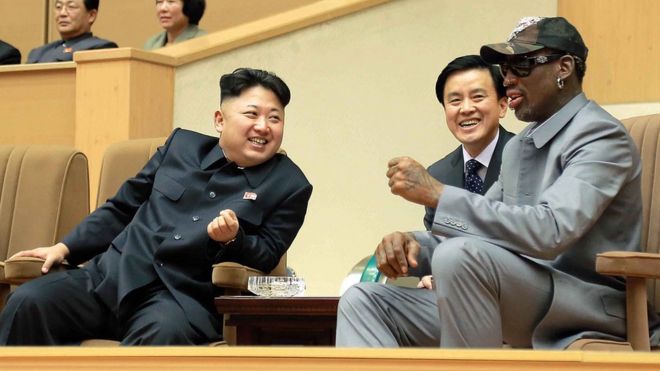
Kim and Trump


Kim Jong-un and Dennis Rodman watching a basketball game in Pyongyang in January 2014
Photo: AFP/Getty

The news that President Trump has suddenly decided to meet Kim Jong Un caught everyone by surprise. At this point, aside from conservatives who support Trump, I haven't seen anyone who really thinks that this is a good idea.

Widely respected North Korean expert, Victor Cha, for instance, wrote in The New York Times that "But that is Mr. Trump’s world — black is white, front is back, chaos is good," essentially warning that this is an amateur hour in the White House. Both Tom Nichols and General Michael Hayden essentially think that Trump is walking to North Korean trap that had ensnared every single leader before him.


Are they right? At this point, though, I am keeping my powder dry.  We need to see what's on the table first, before freaking out that the US is setting loose a bull in a China store, with a disastrous results.

I think it is useful to think about what brought North Korea to the negotiating table. Three points immediately come to mind.

1. The sanctions worked, Ki Jong Un is afraid of Trump, and he is desperate for a deal.

I agree that the sanctions worked, and most likely North Korea is feeling the pinch. Taking a page from the Kim’s old playbook, Pyongyang has decided to offer some "concessions" to the US, before pulling out again, leaving everyone else holding the bag.

Still, the question is, of course, whether Trump is that stupid and whether North Koreans think Trump is that dumb to fall for such a gambit? Granted, Kim might well believe that he can manipulate Trump’s ego. Plus, keep in mind that the North is using a conciliatory partner in South Korea as an intermediary here, which might indicate that Kim thinks he’s in the driver’s seat.  

On the other side, we have to factor in Trump’s weak domestic political position as well as his narcissistic personality, two things that could be driving Trump to accept Kim’s offer. With this in mind, then, Victor Cha's fear might not be unfounded, that Trump might be tempted to show the world that he is the best negotiator by pulling what Cha termed as a "big bang" approach, basically end up giving North Korea everything it wants while getting nothing in return.

But until I see the end result of the deal, I am holding my fire, as I don't think Trump is that dumb. Chaotic and impulsive, yes, but not so stupid as to not get some concrete concessions from Kim. Plus, I do think that he will also consider Japan's interests, since I think based on his visit to Japan last year, it seems to me that both him and Abe managed to get along very well.


2. Kim Jong Un is pulling a "Nixon comes to China."

Kim Jong Un doesn’t trust China, as I wrote in my Global Asia article, and think that the United States might be a better partner in the end. Kim just might believe that too. This is evident in the fact that Kim has not visited China once -- and the fact that Trump will be the first leader that he will ever directly meet means a lot in this face-oriented society of China, Japan and Korea. But whether this means Kim is prepared to denuclearize is doubtful. Kim has built his legitimacy around the issue of nuclear weapon. And he also must aware of the fate of Gaddafi, who gave up his nukes and the United States helped to topple him in the end. Moreover, while it is possible that Trump may stick to his word on any potential deal with North Korea, there is no guarantee that Trump's successor may behave the same. Kim is acutely aware of this.

3. Kim is in a position of strength.

Perhaps flush with confidence, given the success of North Korea’s missile program over the last year, he invited Trump to talks, believing he’s now in a position of strength. In short, he’s ready to bargain now that he has the ultimate chips, nuclear weapons that can potentially hit much of the United States. While it is tempting to think about that, I doubt that Kim is that self-centered, inviting Trump just so he could gloat or give him a fait accompli. That would only limit his options both in the short- and long-term.

Saturday, April 29, 2017

Trump Foreign Policy: Change or Not?


For last few weeks, there has considerable discussion in the US about whether there’s change afoot in President Donald Trump’s nascent foreign policy—specifically, whether he’s bending and shifting his so-called “America First” foreign policy more in line with traditional Republican foreign policy values and interests. Those who believe this is the case point to a slew of recent events and statements emanating from the Trump White House: the US air strikes and bombings in Syria and Afghanistan, Trump's public support for NATO, his administration's criticism of Russia, and a palpable de-escalation of tensions with China. In total, these moves may signal a foreign policy direction for Team Trump. But is it? And what’s really going on here?

Below CWCP President Dr. Brad Nelson and CWCP Vice President Dr. Yohanes Sulaiman offer their takes on these topics.

Yohanes Sulaiman

Trying to describe and explain Trump's foreign policy is basically, in my view, trying to answer whether structure or agency is more important. With regards to structural analysis, one could make a strong argument that Trump's recent moves toward "mainstream" GOP foreign policy is basically a result of structural push-back. For instance, in trying to unilaterally punish China economically, he found out that China supposedly holds the cards that might allow him to solve North Korea problem. Similarly, he is moving against Russia because that's the only way for him to deal with Syria problem. As a result, he ends up moving to conventional/mainstream GOP position.

That said, the agency part here is also important: whichever part of the globe Trump is focused on is based on Trump’s whims. And we can actually also make a strong argument that Trump's cajoling China or throwing missiles at Syria is a part of bargaining, in the sense that Trump remains unpredictable, outside the mainstream GOP policy, but he capitalizes on it, thus making moves that catch his domestic and foreign opponents off guard. Assad most likely didn't expect Trump to attack him due to Trump's perceived closeness with Russia. Similarly with North Korea, by dangling the carrot of economic cooperation and the stick of retaliation, Trump might be able to pressure China to actually do something about North Korea. This negotiating stance, which to borrow Nixon's term, the Madman theory, would be outside the GOP's mainstream position.

Brad Nelson

That's an interesting take. But it assumes that Trump's foreign policy really has changed in concrete, significant ways. I look at it this way: I separate Trump's foreign policy goals from his and his staff's statements and the actions taken/implemented by Team Trump. Regarding the latter, sure, there has been considerable shifts and turns since January. Indeed, we seen changes on this front from Trump himself, on NATO, Russia, intervention in Syria, his willingness to use force more generally, and so on. And there's been public pivots and mixed signals within Team Trump. Most notably, it seems as if almost every comment by Nikki Haley is contradicted Trump and his spokesman Sean Spicer.

But all the statements and actions by the White House are done in the service of some foreign policy goal or goals. That's the point of them; they're put out there or implemented to achieve certain outcomes. And so, in my mind, the bigger issue is whether Trump's foreign policy goals have changed in the last three months. On this matter, I'm not so sure. And this is what some hardcore Trumpites are currently arguing, in response to the prevailing view that Trump is forming foreign policy in a random, ad hoc manner. They believe his goals haven't changed at all, and that Trump is flexible in pursuing these goals. In other words, the words and tools used by the US vis-a-vis various global problems and issues might vary over time, but the overarching foreign policy goals will remain mostly the same. Sure, there is a self-serving, partisan aspect to this argument, but it also has some merit.

I think of the 59 missiles recently launched on Syria as one example. American pundits, commentators and analysts were breathlessly quick to proclaim this act a decisive shift in US foreign policy. After all, he campaigned on keeping the US out of needless foreign wars, especially the one in Syria, even going so far as to signal that he'd be willing to delegate the issue to Russia to solve. But additionally, US intervention in Syria up to that point had been solely directed against AQ and ISIS members and activities. So, in their view, the attack on Assad was something new and different--and also something good. This crowd loudly cheered the attack, seeing it as a just and proper punishment for Assad's use of chemical weapons, and something that was long overdue, since Obama walked back his infamous red line years ago.

Meantime, Trump did suffer a temporary blowback from a part of his base as a result of the attack on Syria. These folks started to worry that he'd betrayed them. Was he becoming a normalized GOPer? Were establishment GOPers getting the upper hand over Trump in their battle with outsiders like Steve Bannon? And where was the restrained foreign policy they voted for? Bombing Syria isn't American First, is it?

But in the end, much of this is massive hyperbole. A one-off, limited attack on Syria does not portend deeper US involvement in the war. And since the attack, US defense officials have declared that there aren't further plans to attack/oust Assad. Moreover, there's reason to wonder whether the attack was done solely with Assad in mind. At the time of the bombing, he was meeting with Xi Jinping at Trump's "Southern White House" in Florida, and so it's possible the timing of the attack purposeful: yes, to punish Assad, but also to send a signal to Xi that he's not a pushover, that he's a strong, decisive leader. Of course, there are other possible audiences as well. The North Korea problem has seemingly loomed larger over the last three months, with the Kim cabal and Trump and his staff publicly sparring. It's very possible that Trump hoped the Syria bombing got Kim's attention, serving notice that Kim ought not to test Trump. And lastly, because of a host of scandals and investigations, Trump has been battling low approval polls since the inauguration. It would not be a surprise if the hyper-sensitive Trump thought that bombing Assad would add a distraction into the news cycle and offer a brief rally around the flag effect for his benefit.

But let's get back to the discussion of Trump's foreign policy goals. It seems evident that Trump's main foreign policy goals center around a handful of projects: (1) improving relations with Russia and China, (2) combating terrorism, (3) reducing the threat of North Korea, and (4) bringing more, better jobs back to the US. Does anything that Team Trump has said or done over the last month or so undermine these goals? Not really, right? I mean, I'm not seeing much change on those fronts. The #MOAB was just dropped on ISIS tunnels in Afghanistan; more anti-terrorism troops have been sent to Syria; Trump's already vetoed the TPP, may open up NAFTA, and extracted some Chinese investments while Xi was in town. And Trump hasn’t backed off the notion that better US-Russia ties are a desirable goal.

Oh sure, some will point to the White House's more stringent comments on Russia's actions in Syria, in addition to Trump's statement that US-Russian relations are at a low point, as evidence that big policy changes are in the works. Perhaps, though I'm skeptical. With the hubbub surrounding Team Trump's possible collusion with Russia to win the election, Trump has an incentive to publicly distance himself from Russia. It's one of the paradoxical outcomes we may find going forward: while Trump campaigned on having good ties to Russia, and he may still want the US to have better ties with Russia, the election shenanigans and the subsequent investigations may well force him to pump the brakes on improving ties to Moscow and giving Russia the concessions it desires (lifting of sanctions, reduced support for NATO, etc.). But before we declare Trump's proposed outreach to Russia completely dead, we need more information. In particular, I'd like to know what what's being said behind the scenes: just because public rhetoric on Russia may be heating up a tad from Team Trump, that doesn't necessarily mean that's what's being communicated to Russia privately, away from the public's eyes and ears.

Thursday, November 10, 2016

US Presidential Election: What Happened and Quick Predictions

So what happened in the election? Short answer: Middle America, the so-called flyover states, decided that the US (and probably the rest of world too) needed a swift kick in the butt. Calvin and Hobbes sum it up well, I think.


Yes, Hillary is probably the worst candidate that the Democrats could have nominated this election year. But that ignores the question of why Middle America is angry. As JD Vance noted in his book, Hillbilly Elegy, these folks are in a lot of pain. And worse, they are ignored, by a liberal political elite who fixates on identity politics and culture wars and belittles their concerns. 

Trump, in essence, is their outlet, their way to give the liberal elite a big middle finger. Do they really believe that Trump is going to build the wall and deport all immigrants? No, most of them don't. In Peter Thiel's words:

I think one thing that should be distinguished here is that the media is always taking Trump literally. It never takes him seriously, but it always takes him literally. ... I think a lot of voters who vote for Trump take Trump seriously but not literally, so when they hear things like the Muslim comment or the wall comment, their question is not, 'Are you going to build a wall like the Great Wall of China?' or, you know, 'How exactly are you going to enforce these tests?' What they hear is we're going to have a saner, more sensible immigration policy.

In short, Americans voted for a hyperbolic showman in order to shift the conversation to things that really matter to their lives. Whether they will achieve their goals is a huge question mark. Trump will have to face his biggest test: governing.

So what's next for the world?

I would argue that, Trump being Trump, he doesn't really care much about the American ideals of spreading democracy, improving human rights conditions in foreign nations, etc. In fact, I predict he will be both isolationist, in the sense that he won't attempt to expand American power abroad to protect human rights, and businesslike, in that he will solely focus on making deals. I know that this is cliche, but I think he will be Putin-like: he will be quite coldblooded in his foreign policy dealings, probably not dissimilar to pre-Carter US foreign policy.

While this may be outrageous to many people hoping to have the United States to maintain its ideals, Trump might actually drive a stronger and more effective foreign policy. But the key question is whether Trump has the discipline to do so. Plus, he needs to deal with skeptical leaders from all over the world, who wonder whether Trump is a showman who can actually deliver or just another snake-oil seller.

Many people, in the US and around the world, believe that he is unsuited to govern. Obama even declared that Trump is unfit to be the president of the United States. So in the end, it could very well be somewhat easy for him to prove his critics wrong because he has such a low bar to cross. Strange as it may sound, seeming only slightly sensible on governing issues is probably a big win for him politically.

Friday, June 24, 2016

Brexit: What Happened and What's Next?


Photo: Alamy

So what happened? Honestly, I am still digesting the Brexit vote myself. On one hand, I don't want to be seen as saying "this was predictable" since this wasn't -- I am as surprised as everyone else. On the other hand, I do think that this phenomenon is not that dissimilar to the rise of Trump in the US: a major silent majority, comprised of whites, old people, people who've lost out against globalization, people living in "rust belt," all voting with  emotion to make Britain great again. They are the left-behinds of this globally interconnected world that has created a huge inequality gap among the rich and the poor. They are the ones who resent Brussels' red tape and do not feel that European Union really reflects their political preferences and attitudes. 

Are the voters racist? I doubt it. I'd suspect really few of them are racist. Yes, immigration is one of the top British concerns, but fearing job theft or incoming radicals doesn't make them goose-stepping totalitarians. In fact, branding the pro-Brexit voters all as racist is the easiest way to cop out, to avoid asking the real tough question of what went wrong. Why is there a disconnect between these people and the political/economic elites/experts, in London as well as in the EU home offices.

Considering that most of the experts were pro-Remain, I think there's a significant undercurrent now against this "educated class," that many people no longer trust so-called experts, seeing them as just tools for corporation interests.

And it is interesting that instead of asking what went wrong, why this identity of being European only germinates among the rich and political elite and does not trickle down to the lower class -- leading to the rise of right wing parties all over Europe -- the overwhelming reaction, from pundits, analysts and politicians, simply blamed the voters. In fact, with the aid of hindsight of course, there were warning signs about the continued viability of the entire European project. After all, some European Union countries only ratified treaties after major concessions, and some didn't even hold a referendum for fear of rejection at the ballot. I mean, if the EU is so popular, brings so many tangible political and economic benefits, then why all the political gimmicks?

What's next?

One answer is heightened uncertainty, which leads to turmoil in the market--something that has already started today. Britain has to renegotiate a lot of treaties, and with the feeling against Britain in Continental Europe, plus the prospect of seeking their own exit, it's unlikely the EU will grant London many, if any, concessions. Moreover, US economic stagnation combined with the rise of populist sentiments within America means that Washington probably won't help the Brits much at all--either now, under Obama, or under his successor, Trump or Clinton. So Britain is basically alone. Expect at least short-term, if not long-term, economic pain.

And then there are questions about Scotland. As expected, the Scots are already pushing for second referendum, which may be successful this time. But whether that would benefit the Scots is doubtful -- the Scots won't add much to the European Union, and with the price of oil at $50/barrel, they would be another weak economy country begging to get in the European Union. Keep in mind that England actually subsidized the Scots, not the reverse. And while many European countries would love to see Britain get its comeuppance, it is doubtful that they'd actually risk invigorating secessionist movements in Spain and Italy and even in Belgium, outcomes which would only add more headaches to the region and to the EU itself.

We may see more backlash against immigrants, particularly in the form of a political crackdown against them, so as to dampen the apparent right-wing awakening across Europe.

In terms of security, I doubt we'll see much change. Regardless of how much everyone is hating the Brits right now, England is one of vital elements within NATO and the entire European security architecture. There's no way Continental Europe is going to kick the Britain out or to modify the extant security arrangement. Frankly, those agreements and institutions have never been a problem and won't be in the future.

Lastly, in terms of international relations scholarship, there will be a lot of rewriting on the institutions literature. What seemed to be irreversible before is now actually reversible. And the case of Brexit/EU may be relevant to other cases, especially ASEAN, where the current model is closely hewing to the European Union model. With ASEAN currently in mess, it is possible that there will be rethinking of ASEAN in near future.

Thursday, July 2, 2015

Why the European Union will not give in to Greece's demands


There has been much discussion already about the "Grexit" and its possible implications to Europe and the global economics, so I won't touch that. What I want to discuss, however, is the logic behind Greece's negotiating strategy, which is supposedly based on game theory. In fact, Yanis Varoufakis, the Greece Finance Minister, is a noted expert on game theory and even wrote a book on it. The strategy, as glimpsed by the New York Times:
Those on the other side of the negotiations are “portraying me as an irrational fool, which is doing my work for me,” Mr. Varoufakis said. “I’ve been stoic. I haven’t let myself get agitated.” Speaking like a true game theorist, he added, “I know who I am and I know they know who I am.”
Apparently, Greece is playing a game of chicken, where due to a weak hand, one of the strategies to get the best outcome is to act recklessly, irrationally, taking the path that everyone thinks and knows would give the worst reward out of all possibilities and thus forcing the other "rational" actors to give concessions. For instance, many believe that if Greece is forced to exit, then it would be disastrous to the European project.

The problem with this strategy is that the other players must have some confidence that this will be the only game of chicken that they will ever play again.

The European Union is playing on long-term game. Yes, Grexit will be very costly. Yes, it will be disastrous to the "European Project." At the same time, the leaders of European Union, especially in Berlin, must realize that if they, in the end, concede to Greece's demands, what will prevent Spain or Italy, which also had to implement painful economic reforms, to play the same game? Or worse, it's possible we could observe another stunt like this from the Greek government. Why would or should the European Union keep surrendering to the blackmails of its weakest and irresponsible members? As noted even by the Italian Prime Minister:
If there is a mass get-out clause over the rules, what will happen in Spain in October? And in France in a year and a half? It is one thing to ask for flexibility amid abidance by the rules. It is another thing to think that one is the craftiest of them all, in other words to be the one that does not abide by the rules. We want to save Greece. But the people of Greece also have to want that.
In other words, EU members don't want a rerun of these chaotic and destabilizing events and thus might have to make Greece, especially Syriza, an example of what happens if anyone dares to pull another stunt like this.

Plus, the fact is that most likely key players such as Germany believes the European Union is much more prepared for "Grexit" today than back in 2009. In other words, they believe that they will survive the game of chicken simply because they have a much stronger car.


So, rather than getting the best possible outcome, the Greek government is actually making a disastrous bet that could end up making it roadkill.

Thursday, April 2, 2015

Obama's Saudi Problem


In announcing the tentative account of the nuclear deal with Iran, Obama did a victory lap. He declared that the negotiations with Iran "had succeeded exactly as intended" and "it is a good deal." And for his role in brokering the tentative deal, Secretary of State John Kerry finally reached his diplomatic triumph and sealed his legacy.

At the same time, the question is how much will this deal change the political calculations in the Middle East?

The answer is, not much. In trying to get Iran on the table, Obama had to upset the regional power brokers, notably Saudi Arabia.

Granted, it is doubtful that the Saudis (and Israel) are going to be happy of any deal short of complete surrender by Iran. Yet, they might be far more willing to entertain even a bad deal with Iran if they trusted that Obama knew what he was doing or at least was more sensitive to their concerns.

Events in the past several days has shown that the Saudis do not trust Obama's moves in the Middle East. They believe the United States was far too eager for a quick nuclear deal with Iran. As Rothkopf noted:
The administration’s good first-term toughness toward Iran on nuclear sanctions was followed by a second-term hunger for a nuclear deal that was so great that everyone from Tehran to Toledo, Ohio, now believes that the United States wants the deal more than the Iranians do and has lost negotiating leverage as a result. 
It is telling when Saudi Arabia didn't bother to warn the United States of their sudden and unexpected invasion of Yemen, which caught the Obama Administration off-guard. The Saudis didn't inform the US because they didn't trust Obama, afraid that Washington would leak the news to Iran. 


More importantly, the Saudis no longer care what the United States thinks, as Mustafa Alani, director of the national security and terrorism studies department at the Gulf Research Center, argued:
We see the beginning of a new policy, where [Saudi] interest is basically more important than U.S. objections or with Security Council resolutions.... Basically, we are adopting the Iranian style and the Israeli style: When it comes to your national interest, you go ahead and do it.
Not surprisingly, Senator John McCain thundered that this development "signals a reality that the countries in the region no longer have confidence or are willing to work with the United States of America." In the meantime, David Rothkopf bluntly stated that Obama's policy in the Middle East was an egregious failure, a giant cluster-fuck. 

In essence, Obama's victory lap is very premature. Should Iran decide to renege even a bit on the still tentative deal before its signing later this year, it will not, for sure, boost the Saudis's confidence on this administration.

Saturday, December 20, 2014

North Korea's Cyberwar


First of all, let me say this: no, I was not planning to watch "The Interview." Not that I am averse to the premise of assassinating a sitting, living foreign leader, mind you. I just don't like James Franco and Seth Rogen's juvenile style of humor.


The cancellation of The Interview shows that it is very easy for any country to engage in cyber war while it is actually very difficult for the defending country to retaliate. In fact, it is very difficult to really pinpoint whom to blame, which is actually the advantage of cyberwarfare  -- unless, of course, you admit it in order to win an election.

Not surprisingly there are people, regardless of their views toward the administration, who have looked darkly on this issue.


Even though the Obama administration still unwilling to name who is behind the attack finally accused North Korea of masterminding the attack, which in turn was met with an unsurprising denial by Pyongyang, it is very difficult to determine what would be the appropriate retaliation for the attack, especially to a country so completely off the grid like North Korea. And the fact that the North Koreans could still strike again has made the Obama administration wary to escalate the situation needlessly.

Saturday, July 12, 2014

What's At Stake for Prabowo


First, let's be clear about one thing: Prabowo Subianto is not stupid. He is a very smart guy with a firm understanding on how politics work. And he created and ran a strong campaign team that nearly won him the presidency.

Therefore, it is very doubtful that Prabowo truly trusts the four survey groups, LSN, IRC, Puskaptis, and JSI, which are currently under fire for publishing questionable results, that have him in the lead. After all, had he trusted those outfits, there's no way in hell he would have been able to close the 30% gap in popularity between him and Jokowi, because these survey groups had been constantly publishing numbers favorable to Prabowo by healthy margin in the past couple of months.

But here's the big question: why has Prabowo decided to fight on rather than concede defeat?

Edward Aspinall and Marcus Mietzner have penned a very interesting analysis that everyone should read at New Mandala. I agree that one of main goals of Prabowo right now is to muddy the statistical waters, making the legitimacy of Jokowi's victory seem questionable. Still, I don't buy the argument that Prabowo is going to steal the result. He must know that virtually everyone is watching the Elections Commission very closely, including the anti-Corruption Commission. The analogy is this: would you steal money from a bank that you know was watched by the entire town?

Instead, he will move through the Constitutional Court. Instead of challenging the count, however, Prabowo could choose to challenge the legitimacy of the entire election. As the Constitutional Court decided earlier:
The court also ruled that the current election mechanism contradicted the Constitution, which considers the legislature and the executive equal in power. “The checks-and-balances mechanism between the House of Representatives and the presidency doesn’t work well.”
Because short-term coalitions form soon after the legislative election for the sole purpose of nominating a presidential candidate, the winner in the presidential election has to include members of those parties in his or her Cabinet, thus reducing the effectiveness of House oversight over the executive, it said.
...
In its Thursday verdict, the court turned down a request that the 2014 elections be held at the same time. The court said that a simultaneous election in 2014, would create “chaos and legal uncertainty”.
[We] suspended the implementation of the ruling until after the 2014 elections. In the future, [the mechanism] should follow the ruling and separate elections are no longer possible,” Justice Fadlil said.
Keep in mind that the court had decided on a judicial review from Effendi Gozali but has not yet answered Yusril Ihza Mahendra's challenge that only a political party or coalition of political parties that won 25% of national legislative votes could nominate a presidential candidate. So there is a chance of actually having judges in the Constitutional Court declare that both the election process and the next government is illegitimate.

Granted, this is a scorched-earth attempt that might alienate many voters -- including his own voters, but that's the main reason Prabowo's team has been accusing Jokowi of attempting to steal the election via public opinion polling firms: to shore up his base so they would be willing to accept this kind of tactics.

At the same time, it is also doubtful whether the PDI-P itself is willing to be dragged into a long, and very expensive legal fight, with the risk of redoing a very expensive election. It is more likely that the PDI-P will be willing to strike a deal, giving a couple of ministries to Prabowo and ending up with stronger position in the parliament.

That, I think, is the main objective of Prabowo's challenge, to squeeze some lemonade from the lemons that the election gave him.

Friday, July 11, 2014

Ten Things That We Learned From Indonesian Presidential Election 2014 (So Far!)

1. Indonesian democracy is doing better than expected (so far)


Even though the result from the Indonesian Presidential Election is currently in dispute, the silver lining is that so far both sides remain calm, haven't resorted to force, and more importantly, are willing to wait until the Election Commission announces the official result on July 22. The fact that both sides remain peaceful mean that both candidates agree that the electoral process and its institutions are legitimate. For all of this, we should give the credit to...


2. President Susilo Bambang Yudhoyono is doing a good job so far


Whether you think President Yudhoyono is a good president or not, it cannot be denied that he managed to maintain order during the entire electoral process. Even though many criticized his last-minute throw of support to Prabowo Subianto, he has so far managed to keep the institutions of the presidency, military, and police force neutral, preventing the situation from spiraling out of control.

Of course the question is what will happen after the Election Commission releases its official result on July 22. The losers will cry foul and the President, considered by many as wishy-washy, might have to act decisively -- because that will have major impacts on his legacy and reputation.


3. People don't trust the General Elections Commission (KPU)


Which may sound contradictory considering that above I mentioned that all sides regard the electoral institution as legitimate. That, however, does not mean that the people trust the commission. Citizens were warned to check their ballot before voting in case of irregularities. There were accusations of ballot stuffing and other shenanigans going on, such as people receiving ballots with only one candidate, a hoax that was believed by many [link in Indonesian]. More importantly, the disputed incident in Hong Kong, gave the impression to Jokowi's voters that the Commission was slanted in favor of Prabowo. 

And keep in mind even the institutions doing the quick count declared that the commission could be at fault should the commission in the end declare Prabowo the winner [link in Indonesian]. And the KPK sternly warned the commission and its counterpart, Elections Monitoring Body (Banwaslu) against vote rigging.  

This was the main reason why Megawati Sukarnoputri jumped the gun, declaring victory even before the results were in during the election day, which in turn angered Prabowo, who believed that Megawati was going to steal the election, because....


4. Many do not understand a "quick count" and how statistics (or math) works

Math is hard!

Done right, a quick count is a great asset for democracy, as it provides control against governments, or anyone else, attempting to steal an election. Done wrong, it creates uncertainties and lack of trust even in legitimate survey institutions. This is what happens in Indonesia, where there are terrible survey institutions masquerading as legitimate outfits, which causes confusion, especially among people lacking knowledge in how statistics works -- and these outfits are paid handsomely for this.

Such chaos would not have happened had anyone or any body, including the Elections Commission, already threw the book at them: these outfits had a track record of manipulating the results of surveys (not to mention giving wildly off-the mark results). But in Indonesia, people generally never try to rock the boat, until... well... shit hits the fan.


5. Horse-trading remains a popular sport


Already, Golkar, a member in Prabowo's coalition, signaled its willingness to switch sides and join Jokowi's administration, should Jokowi finally prevail. Of course, nobody raises an eyebrow, because, well, this is Indonesia.

Expect more horse-trading later, especially as both Jokowi and Prabowo pursue their options.


6. Yes, money matters, but....


But it is more important to know how to use money effectively. Nobody could fault Prabowo in this regard. Prabowo managed to make the race so competitive thanks to his ability to spend money wisely: building a strong organization for campaigning and mobilizing voters, and launching attack ads that questioned Jokowi's ability to govern. In essence, Prabowo knows how to run a great campaign and regardless of whether he wins or loses, students of politics should study his campaign as an example of how to run an effective campaign. 


7. Also black campaigns are here to stay, whether you like it or not


Because it works against unprepared, incompetent and disorganized oppositions.  In fact, one of very few reasons Jokowi won was....


8. Spontaneous, highly motivated grass root support matters


Without political idealists--these highly dedicated people volunteering their time and money--it is doubtful hat Jokowi could prevail in such a tight and ugly race. The volunteers essentially did what the PDI-P failed to do: to mobilize voters and counter negative and black campaigns on Jokowi.


9. Presidential debates help


While presidential debates only change the mind of few voters, they do help to galvanize the supporters of the winning side of the debate. The debates also provided opportunities for Jokowi to regain the momentum from Prabowo -- and missed opportunity for Prabowo to prove that Jokowi was simply not a good presidential candidate.


10. And of course, a little bit of luck always helps


Nobody expected the fiasco of the polling in Hong Kong, and what happened there remains in dispute. And yet, the fiasco, it seems, led to quite a turnout from the Jokowi voters.

And we end this list with a song.


No thanks to PDI-P: Jokowi wins despite poor campaign


Joko Widodo’s supporters organised a concert that managed to mobilise youth voters
to support him. 
Hendrik Mintarno/Flickr, CC BY-NC-SA
This article is cross-posted at the Conversation.

Despite an ineffectual campaign by Indonesia’s Democratic Party of Struggle (PDI-P), Jakarta governor Joko Widodo won Indonesia’s presidential election, according to quick count results.

Data from reputable survey centres such as SMRC (Saiful Mujani Research & Consulting) showed a 3-5% margin of victory for Jokowi, Widodo’s popular nickname.

This apparently comfortable margin, however, does not reflect how tight the race was. Former military general Prabowo Subianto almost snatched victory from the jaws of defeat in a race that Jokowi was supposed to win easily. Six months ago, surveys showed he had four times more popular support than Prabowo.

With intense campaigning, Prabowo managed to close the gap in opinion polls just before the election. Prabowo still has yet to concede defeat, relying on four (of 11) quick count results that show him leading. The Indonesian Election Commission will announce the result on July 22.


Slow start for Jokowi

Before April’s legislative election, Jokowi had a commanding lead in opinion polls of around 30%. But he started his campaign with a severe disadvantage. The PDI-P selected him as the party’s candidate only very late in the legislative campaign period.

The PDI-P did not prominently promote Jokowi in most of its campaign material. The party’s ads show either chairwoman and former Indonesian president Megawati Sukarnoputri or her daughter Puan Maharani. As a result Jokowi’s impact in the legislative election was minimal.
When votes for the legislative election were finally tallied, PDI-P’s share of votes was far below the high (and often unrealistic) expectations. Many commentators and even people in his own party started to blame Jokowi. They questioned whether the “Jokowi Effect” actually exists.

Further compounding the problems, Jokowi had to wait until he received Megawati’s approval in mid-March before he could become the PDI-P’s presidential candidate. Much to his disadvantage, he could not respond to smear campaigns that began to swirl during the legislative election campaign. Worse, his waiting for Megawati’s approval provided his opponents with ammunition to cast doubt about his ability as a leader.


Prabowo went on the offensive

Prabowo did not have Jokowi’s problem of trying to become the standard-bearer of his party. But he had two main challenges: his poor human rights record and his lag in the polls.

Prabowo had to campaign aggressively. He built a huge coalition of several political parties. He expected the party machinery to turn out votes for him.

Prabowo also counted on his coalition partners to attack Jokowi with a barrage of negative campaigns to create doubt in voters' minds. Backed by media moguls and his billionaire brother, Hashim Dojohadikusumo, Prabowo had an effective campaign team that spread his message all over the place.

The tactics worked, thanks to the ineffectual responses from Jokowi’s team. By the end of June, Prabowo was neck-and-neck with Jokowi in the polls.


Jokowi’s lucky factors

Several factors helped Jokowi salvage his campaign. First, and most importantly, Jokowi managed to attract a number of dedicated volunteers who were willing to spend their own money and work tirelessly to spread his messages to voters.

The effect of those volunteers could hardly be overestimated. They organised a massive pro-Jokowi concert on the weekend before the election. The concert, which was held on the same day as the last presidential debate, managed to mobilise youth voters to support him.

The second factor was the presidential debates. While the debates did little to influence undecided voters, the main purpose of the debate for the campaigns was to mobilise and energise the debate winner’s supporters.

Here, Prabowo failed to use the debates to question Jokowi’s fitness as a leader and undermine the moral of Jokowi’s supporters. Instead, Prabowo appeared unprepared in the first debate. Meanwhile, Jokowi and his running mate, Jusuf Kalla, used the the debates as a showcase of their program and can-do mentality.

Prabowo and his running mate, Hatta Rajasa, performed well in the second and fourth debates. However, Jokowi and Kalla handily won the final debate. That momentum continued to election day.

The third factor, which was beyond anyone’s control, was the fiasco of the polling in Hong Kong. Hundreds of Indonesia’s migrant workers were denied the right to vote after the polling station closed at 5 pm (HKT) on Sunday. The Indonesian Election Commission was accused of purposely preventing Jokowi’s supporters from casting their votes.

While the details are still sketchy and in dispute, this created an impression among Jokowi’s supporters that Prabowo had managed to turn the system and the Election Commission against them. This incident galvanised Jokowi’s supporters and increased their turnout in Wednesday’s election.

These three factors helped propel Jokowi’s recovery. He thus managed to stem his losses and prevail against Prabowo. It was a close call, though, and Jokowi won in spite of his party’s poor performance.