Center for World Conflict and Peace

Center for World Conflict and Peace
Showing posts with label Author: Brad Nelson. Show all posts

Friday, January 8, 2021

The Attack On the Capitol Building


Wednesday, January 6 (2021) will be remembered as a seminal catastrophic moment in American politics, much like how history views 9/11 and the bombing of Pearl Harbor. The foundations of US democracy—both symbolically and literally—were invaded and attacked. Hundreds of crazed Trump supporters, stirred up by President Trump and other elected Republican officials and aggrieved by Trump’s election defeat, attacked the Capitol building—the very seat of America’s legislature, and arguably the most iconic building in the US—in the most destructive attack on the Capitol in roughly two hundred years. Windows were smashed, offices were vandalized and ransacked, and fights and gun battles erupted, resulting in the deaths of five people, including US Capitol officer Brian Sicknick, and more than 50 injured. At this point, almost 100 attackers have been arrested and more will surely suffer the same fate in the coming days.

Presumably, Trump’s goons believed that by storming the Capitol, they could unleash a series of moves that would prevent Joe Biden’s electoral win from becoming official and enable Trump to retain the presidency. The Trump putsch failed, of course, as police, after a few hours, were able to clear and secure the Capitol and push the mob of people away from the building. Still, US democracy suffered a near-fatal blow, and it’s no overstatement to say that it could take generations for Americans to fully reckon with and recover from the Trump years and Wednesday’s attack in particular.

Unfortunately, I’m not surprised by the course of events. Back in late September, on this blog, I described the decrepit state of US democracy, US politics, and the potential for post-election violence. “What will Trump do on Election Day and beyond? My guess is that he will declare victory, no matter if he's in the lead or not election night. He'll gin up his base, working them up into a frenzy in his speeches on his Twitter page. He’ll use all sorts of vague and coded language, encouraging his supporters to “stay vigilant” and “not let the Democrats steal the election,” and so on. Then he'll try to get a GOP-leaning Supreme Court, assuming Amy Coney Barrett takes a seat before November, to toss out thousands of ballots in battleground states, with the hopes of overturning the election. I mean, it's crystal clear what he intends to do. During the debate, he admitted he sees the Supreme Court playing a role in adjudicating the election. If the courts rule against him, trouble could still loom. All of the people Trump ginned up will seek an outlet to release their pent up frustrations and anger. And at that point, there’s the very real prospect of armed pro-Trump groups taking to the streets.” It was easy to forecast the coming catastrophe, as Trump himself signaled his intentions to hold on to power through any means necessary, even if that meant bending the rule of law to his whim and inciting his followers to commit heinous acts. And that’s exactly what happened.

Surely, Trump deserves his share of blame. And he’s deservingly getting it—from the mainstream media, academics and policy wonks, some Republicans, and Democrats, who plan on bringing forth a second round of impeachment charges very soon. For years, dating back to the start of his political campaign in 2015, Trump has mainstreamed far-right political extremism by peddling xenophobic, racist, violent, and lawless rhetoric. And he’s cozied up to white nationalists and Neo-Nazis, refused to distance himself from QAnon and other conspiracy theorists, and embraced a wide swath of homegrown and international political fanatics—exactly the types of people who attacked the Capitol. Over the years, Trump’s supporters have responded accordingly by engaging in or threatening to carry out various hate crimes, terror plots, and assassinations in his name. In short, then, it’s not as if the Capitol building attack is something out of the blue for the extremist, fringe element of Trump’s base.

The proximate cause for Wednesday’s mayhem traces back to Trump’s November election loss. He has recklessly claimed the election was rigged and stolen from him, buttressing his claims with a steady stream of lies and conspiracy theories. On Twitter, in public statements, and at campaign rallies since Election Day, Trump has encouraged his supporters to resist the election results and prevent the election from being stolen from him. And on Wednesday, at the “Save America Rally,” spoke for an hour, instigating the crowd “to stand strong,” “to fight,” “to get tougher,” and “telling supporters to ‘stop the steal’ of the election, urging them to head to the Capitol to demonstrate against Congress certifying President-elect Joe Biden's victory.” Many believe these words incited the mob, only minutes after Trump spoke, to storm the Capitol.  

But Trump isn’t the only one to blame for the attacks. The extremists and insurrectionists who carried out Wednesday’s putsch clearly also share blame. These are the people who’ve been radicalized—by Trump, by other radicals, by radical media outlets—to attack the Capitol, fantastically believing that this would save America’s democracy. And for the past four years, they have slavishly and cultishly devoted themselves to Trump and his pet causes—hanging on his every word, turning out in droves to his political rallies, buying Trump hats and memorabilia, serving as an Internet troll army, and causing death and destruction in Charlottesville, among other things. In the end, they were duped by Trump to serve his personal ends and left with little more than red hats, lots of anger, and a raging pandemic.   

The Republican Party also shares some blame. Almost across the board—except for Mitt Romney and Justin Amash (who later left the Republican Party)—the GOP has failed to provide effective guardrails on Trump. Instead, they’ve been perfectly fine with coasting on Trump’s political coattails, drafting on his popularity within the party, to gain and hold political power. The GOP’s coddling of Trump has aided and abetted his repeated efforts to subvert America’s democracy, the spike in white nationalist violence, and the radicalization of the political right in the US.   

Lastly, the far right-wing echo chamber of television, radio, and social media has played an important role in stirring up trouble in the US. While Fox News and Fox News personalities, like Sean Hannity and Tucker Carlson, still dominate the right-wing and far right political discourse, they are no longer the hegemon, as OANN, Newsmax, Gab, Parler, and other radical Internet sites and message boards have grown in popularity. All too frequently these actors serve as veritable mouthpieces for Trump and his administration, parroting his views, his conspiracy theories, and his outright lies. Moreover, at times, they independently act to advance Trump’s cause, creating their own narratives and storylines—sometimes based in fact, but frequently not—to bolster Trump’s agenda and undermine the Democrats’ policies and political power. The far right wing mediasphere, much like Trump, plays a pivotal role in radicalizing Americans, telling them what they want to hear, creating fictitious enemies, glorifying Trump and the GOP, and ginning them up to be perpetually angry and aggrieved. In fact, the far right-wing media has helped to foster a cult-like atmosphere in which Trump is treated as a savior, heaven-sent to solve America’s problems and to beat back the Democrats and other undesirables. And that, in turn, has spawned the deification and considerable iconography of Trump (hats, t-shirts, flags, etc.).

Now, the insurrection is terrible, and the roles the aforementioned players played in causing or provoking the Capitol attack is also terrible. But as bad as those things are, there’s an even bigger problem. Trump, the GOP, and the far right-wing mediasphere have created a monster they can no longer control. The Capitol attackers were not simply lawbreakers, they were an incredibly violent group. They possessed materials for napalm, assault weapons, bombs, nooses, zip-ties, and so on. This wasn’t a situation in which peaceful protesters showed up to Washington, DC, on Wednesday to voice their political views and things suddenly and accidentally got out of control. No, this was a pre-planned event, according to online chatter, and the attackers were well-prepared to use violent tools if necessary. We’re lucky the attack only resulted in five deaths, as it easily could’ve resulted in a very bloody mass-casualty event.  

Additionally, the Trump mob is angrier than ever, seeking revenge not only against Democrats but against any Republican who, in their view, has turned on Trump. For instance, according to a report, members of the crazed mob were looking for Vice President Mike Pence, hoping to find him and execute him for his “crimes” of recording the Electoral College results. Despite years of yeoman’s work of supporting Trump, Lindsey Graham’s recent declaration to “count him out” has made him, like Pence, an enemy of hardcore Trumpers. I expect the enemies list to grow as more Republicans actively denounce Trump and distance themselves from him in the waning days of his tenure.

Furthermore, just because the violent attackers have now went home, and some have been arrested, that doesn’t mean they’re done. They’re riding a major high right now. The Trump mob believes they scored a victory. They managed to breach Capitol security and get into the building, scared the hell out of Congress, received days of free media time, and create political chaos. As a result, the MAGA insurrectionists are emboldened; they are all-in in their continued fight to defend Trump, dethrone the Democrats, and cause further bedlam.

Attempts to cope with the fallout and implications of the Capitol attack cannot come only from the political left in the US. Both parties, in a united front, must attack the ongoing scourge on US democracy. America cannot leave far right violent mobs any political space and freedom to operate. While a comprehensive plan to deal with the ongoing political extremism and strife is beyond the scope of this post, I can offer a brief list of items that politicians on the right and left should consider. In particular, bipartisan efforts should made to: tone down the political rhetoric; condemn violent, seditious political acts; discourage violent, seditious acts; make it abundantly clear that the rules, norms, and laws apply equally to far left radicals; work with social media companies, helping them to create sensible and transparent--rather than ad hoc and reactive--policies that effectively balance free speech protections and the safety of Americans; and ostracize and punish Congresspersons who endorse/are complicit with extremist language and political acts.

Finally, I also think Congress—and politicians in general, at the state and local levels—needs to up the fight against Covid-19. Covid is a separate but related issue to the political struggles America now faces. The fact that so many Americans are sick, have died, and are out of work has raised the political temperature by several degrees in the US over the last 12 months. The faster the Biden administration can make major in-roads in beating back the virus, the quicker Americans can return to their normal work, school, religious and entertainment environments. And that will help in dialing down the rage of people who despise being confined and the restrictions on their personal freedoms.  

Sunday, May 31, 2020

America Is Coming Apart at the Seams


                                            Protesters demonstrate as a store burns in Minneapolis. (Joshua Lott/The Washington Post)


We are seeing dark and scary times in the US. 100,000 plus are dead from the coronavirus. There are now than 40 million unemployed Americans and the unemployment rate hovers around 15%. And Americans are rioting and cities are burning.

The coronavirus has shut down the US for roughly two months, and only this week are most states opening back up. The virus, with its grim death toll, has been headline news for weeks now. And orders by authorities, such as “shelter-in-place” and wearing masks, and so on, have been subjects of political fighting between the right and left. With the Americans stuck indoors, economic life has ground to a halt, with dramatic consequences. Millions of people are out of work or furloughed, seeking unemployment, and desperate for life to return to normal. While the majority of Americans have taken the virus and its effects mostly in stride, understanding the severity of the health crisis and the need to stay indoors and maintain social distancing, there’s a pocket of citizens who are angry. Angry at medical professionals. Angry at politicians. Angry at the WHO. Angry at the virus.

On top of all of that, we now have another prominent case of police brutality against a person of color. On May 25th, an African-American man from Minneapolis, Minnesota, George Floyd, apparently, attempted to make a purchase at a deli using a counterfeit $20 bill. (It’s still unclear whether he even knew he possessed fake money, or whether he deliberately tried to swindle the deli). The deli called the police in response. But the four officers who were dispatched to the scene made a minor situation far worse. An unarmed Floyd was handcuffed and showed little resistance, though the police pushed a shoved him around. Eventually, three of the officers were on top of Floyd (while the other officer stood guard), subduing an already subdued guy, and one of them grinded his knee into Floyd’s neck for almost nine full minutes. As this happened, Floyd clearly suffered, claiming he couldn’t breathe. The police showed little interest in Floyd’s struggles, and he died on the street, in the exact spot where he was savagely detained. In response, the four cops were fired. Additionally, the officer who killed Floyd was charged on three counts, including 2nd degree murder, while the three other officers were charged with aiding and abetting 2nd degree murder.

People of color and their white allies are justifiably angry and frustrated about the Floyd killing, specifically, but also by the years and years of police brutality and rampant political, economic and social discrimination against non-whites. Additionally, please keep in mind there is also a larger recent context to these developments. The number of hate crimes are way up. The presence and activities (in the streets and online) of white nationalists are an increasing domestic threat in the US. On several occasions, President Trump has aided and abetted, even given cover to, violent white racists. Furthermore, the Floyd murder is only the latest in a string of recent killings of African Americans (Breonna Taylor, Ahmaud Arbery, etc.) by police and/or white Americans. Viewed in context, then, racial tensions have been simmering, and the Floyd murder catalyzed people into action.  

Protests and violence first broke out in Minneapolis, and have spread across the entire US. Since May 26th, protests, violence, and mayhem have hit the US. Heavily militarized police are on the streets. Unmarked security forces--secret police?--are on patrol in Washington, DC. Protesters and police have fought; police have even used gas against protesters. Buildings and cars have burned. Stores have been damaged and looted. Cities are in complete turmoil. And the political, economic, and social effects will reverberate through the US for years to come.

Most of the protesters have been peaceful and have good intentions, it seems. They’re protesting injustice and taking to the streets to vent their agony. A small contingent of protesters are looking to start or participate in illegal activities, like looting damaged stores. More ominously, according to reports, the protesters have been infiltrated by white nationalists seeking to hijack the moment and cause problems in their name. The infamous "Boogaloo Bois" have appeared at dozens of protests, looking to menace and threaten protesters. And similarly, unaffiliated armed white dudes have shown up in Philadelphia (baseball bats and hammers) and Indiana (guns). Three white extremists in Las Vegas were arrested on terrorism charges, including "conspiring to carry out a plan that began in April in conjunction with protests to reopen businesses closed because of the coronavirus and later sought to capitalize on protests over George Floyd." And we know white supremacist social media platforms are actively encouraging members to use violence in the hopes of starting a race war--an idea known as "acclerationism" and is popular among white supremacists.

It’s easy to take a narrow view and look at all the health and economic problems as unrelated from the protests and racial issues in the US. After all, the former two issues (health crisis and the economic fallout) and the latter one (protests) have different proximate causes—the coronavirus with respect to the first two, the killing of an unarmed black man regarding the last one. Moreover, racism, police brutality, and violence against people of color have a long and distinct history in the US. But are they really different from each other?  

I think if we zoom out, we see something different. I do, at least. I see the internal crises in the US—health, race, political, economic crises—the result of a profound leadership problem. Simply put, the ongoing chaos in the US is the impact of bipartisan national leadership failures. Americans are sharply polarized, increasingly indifferent to the plight of others on the opposite side of aisle, can’t agree on facts, and can’t even agree on who or what America is. Why? Because national Democrats and Republicans have prioritized power above all else, and have engaged in a protracted power struggle, politicizing everything while failing to stand up for national unity, America’s democracy, and moral decency and rectitude. I’m willing to place more blame on the GOP, but the Democrats aren’t blameless here.   

Let’s look at the culprits in brief detail.

1. Trump is a massive failure. He’s grossly incompetent. He’s a narcissist. He’s a habitual liar. He routinely engages in race baiting. He spouts conspiracy theories. He’s an authoritarian. And he clearly has little to no moral backbone. His modus operandi right now is to get re-elected in November. If that means he has to figuratively or even literally burn down the US in the process, then so be it.

His performance on COVID is embarrassing. For weeks, he downplayed, ignored, and failed to act on guidance given to him by his own government. His delayed response cost roughly 36,000-54,000 Americans their lives, according to research from Columbia University. He’s recommended a host of downright ridiculous and dangerous home remedies to combat COVID, against the advice of medical professionals. He’s repeatedly patted himself on the back that ONLY 100,000 Americans have perished from the coronavirus. At this point, Trump’s more interested in deflecting blame, with China increasingly feeling Trump’s ire.

Trump has a long and troubled past with respect to racial issues. In 2017, I wrote: “Well before he was a political figure and had to make political calculations about his words and actions, Trump had a checkered past with various identity groups. He (along with his dad and Trump Management) was sued in the 1970s for housing discrimination, played a part in spreading false statements and riling up New Yorkers in the Central Park Five case, and aroused suspicions of bigotry during his Apprentice days. And of course, what helped Trump rise to political prominence, even before his formal participation in US politics, was his 'Birther' antics, a xenophobic and racially-tinged campaign against former President Barack Obama.”

And in his time as president, Trump has fared little better. Trump’s support for white nationalists in Charlottesville in 2017 is but one in a string of examples of his taking the side of violent white Americans. Earlier this year, when armed protesters stormed the capital and threatened Michigan politicians, Trump begged the state to take easy on them. He even stoked the fires of radicalism and violence in April, when he Tweeted, “LIBERATE MICHIGAN!” Of course, this is a marked and intentional contrast to his latest Archie Bunkerisms. In this recent Tweet from Trump, during an extraordinarily tumultuous time, Trump wrote: “These THUGS are dishonoring the memory of George Floyd, and I won’t let that happen. Just spoke to Governor Tim Walz and told him that the Military is with him all the way. Any difficulty and we will assume control but, when the looting starts, the shooting starts. Thank you!” His dog whistle here isn’t very subtle. His answer to the protests supporting the rights of people of color, ostensibly, is to threaten American citizens with violence—a far cry from his position on white protesters. Furthermore, the use of the word “thugs,” in the context in which he used the word, is commonly interpreted nowadays as a racial slur—akin to the N-word—against African Americans.

Frankly, I’m not so sure that Trump is all that bothered by the protests and violence. The ongoing chaos in cities across the US allows him to use tough rhetoric and get a photo-op. Moroever, it enables Trump to play the “law and order” card—used by Nixon and other right-wing politicians over the years—that he’s very comfortable with. Indeed, Trump recently tweeted, “Law & Order!” The instability allows him to play the tough-guy, using and abusing police and military forces for political purposes, and then take credit for cleaning up the mess in the streets once everything has calmed down. The good part is that some prominent military officials, such as former Secretary of Defense James Mattis, are now speaking out, condemning Trump's politicization of the military and his divisive rule. The downside is that Trump is no longer flirting with authoritarianism, but overtly leaning on the tools and strategies of illiberal dictators, which poses a direct and immediate existential threat to America's democracy. How serious is this political and institutional crisis? Esteemed policy wonk Robin Wright, today in The New Yorker, wonders if America is becoming a Banana Republic.

2. Congressional Republicans have failed, too. The GOP has silently abetted and sometimes vocally supported and assisted Trump in whatever he’s said and done during his presidency. How many Republicans have challenged Trump? Overall, Mitt Romney has done a decent job. But who else? The Republican party is now the party of Trump, and so just about every Congressional Republican is worried about running afoul from the party line, which adheres to strict conformity with and praise of Trump. The risk of drifting from the party line, mind you, is that deviant Republicans—those who dare to critique Trump—could get primaried by even “Trumpier” candidates. All of this has degraded and perverted a formerly esteemed political party, transforming it into decoration and puppetry. In exchange for degrading their personal and political reputations and integrity, Republicans (both in and out of Congress) try to take solace in knowing they've gotten their tax cuts and two new conservative members of the Supreme Court. But in consumating that deal with the devil, they've unleashed a political virus that's wreaking havoc on conservatism, the Republican Party, and the US. 

3. Congressional Democrats have also failed. Yeah, Democrats only control the House of Representatives, but they are stakeholders here as well. They can’t just blame Trump and the GOP; they bear some responsibility. And not only that, national Democrats have consistently allowed Trump to dominate them. Of course, he has the bully pulpit and tens of millions of Twitter followers. But if the Democrats were serious—really serious—they could be far more creative in pressing the case for the policies and values they supposedly believe in, and communicate clearly and repeatedly those views to the public. Making television appearances on CNN and MSNBC isn’t enough. Democrats could hold daily press conferences at symbolic sites; plan and coordinate peaceful national protests; commit to formulating a comprehensive domestic policy and governing strategy with meaningful and constant input and buy-in from a cross-section of American society; engage more frequently with and be much more responsive to the interests and concerns of local communities—don’t just hold photo-ops; and so on. This is just a small list of ideas. I’m sure more creative and innovative folks can think of other, better ideas the Democrats could implement.

If there is any ray of sunshine at the moment, it’s the role of some local and state politicians, who are having to clean up the failures of national, federal officials and politicians. This is evident in the case of COVID, as it is in the Floyd case and the ongoing protests/riots. I’m thinking specifically, just off the top of my head, of Atlanta Mayor Keisha Lance Bottoms, Chicago Mayor Lori Lightfoot, and Ohio Governor Mike DeWine. (There are others, and I’m sure some of you might have your favorite. Apologies for overlooking anyone.) They’ve tried to display calm, sensible leadership. But even the mayors and governors, even the good ones, have been overwhelmed by the severity of these crises and haven’t been perfect in their decisions. Governors and mayors of all political stripes have been slow to react to the growing violence and looting. My guess is that they believed that adding beefed up, militarized police to a powder keg situation would only exacerbate tensions. Unfortunately, in the absence of strong policing, swaths of the US, extending from cities into suburban areas, have erupted in anarchy.  

The US is at its lowest point in 50 plus years. It’s not hyperbole to say that America is coming apart at the seams. Americans are out of work, sick, angry, and frightened. And political authorities are largely indifferent, feckless, craven, and incompetent. And the worst of the politicians are actively cheering on the chaos. The answer to the ills of America won’t be found in new leaders or policies. The solution, I suspect, will require a more fundamental reassessment and restructuring of American society. We need to rethink the role of the state, relations between the state and society, and relations between American citizens. Anything less than that will simply paper over the existing deep-seated problems in 21st century America. 

*Note: this post was updated on June 4th. 

Sunday, March 15, 2020

COVID-19 and International Politics


Image result for pictures of people with covid 19 masks
Photo: Kim Kyung-hoon/Reuters 

It’s now been a few months since COVID-19 first appeared and began to spread around the world. The health fallout continues to mount. As of this writing, per the WHO, there are over 150,000 confirmed cases, some 5,700 deaths, and 146 countries/territories have been hit by the virus. Health care facilities and systems worldwide are being stretched to their limits, people are stressed and panicked, and everyday life has been massively disrupted. And making matters worse, the virus doesn’t show any signs of abating anytime soon.

While I am not a medical doctor or professional, which means I can’t credibly address the health and medical side of COVID-19, I am an expert in international politics, and I can reasonably sort through some of the global political implications of the coronavirus. What I’ll do here is focus on one main international political implication: the weakness and failure of international institutions and the liberal order more generally.  

Sounding the alarm about the sorry state of the liberal order has been en vogue for several years now, and these concerns have been voiced and articulated even more loudly and frequently during the Trump era. Unfortunately, COVID-19 just might be the death knell of the existing liberal international order as we know it. Oh, the order might limp on, but any belief that it’s a functioning, effective order is for the deluded and hopelessly Pollyanna.

The liberal order consists primarily of the rules and structures that undergird international relations. These rules and structures often take the form of international institutions, laws, norms, and they are supposed to provide order, stability, and enhanced cooperation in the world, even and at times especially during tumultuous periods. They are designed to fill in the gaps in global problem solving left in the wake of narrow and often selfish behavior and relationships exhibited by states historically. 

Well, right now certainly qualifies as a tumultuous moment, one that’s desperately crying out for global collective action and problem solving. After all, the coronavirus is spreading, people are sick and dying, markets are tanking, and countries are isolating, locking down, and quarantining themselves. According to liberal (international relations) logic, these institutions should be actively responding to the current crisis, addressing the real world health pandemic. They should be greasing the wheels of inter-state crisis coordination, dampening hysteria, and helping distressed people get the care and resources they need.

So is this the case? Is someone/thing leading the effort to coordinate a collective response from the international community? Are international public goods being provided? Regrettably, theory doesn’t always match reality, and this happens to be one of those cases. Indeed, COVID-19 is a glaring example of the failure of current institutions to meet the challenges of today.

Since the end of WWII, the US has acted as a global first responder and public goods provider—in part to expand its influence, and in part because institutions like the UN have shown to be troublingly ineffectual. Arguably, America’s self-appointed role as a first responder and public goods provider has been a mixed bag. On the one hand, it led to meddling in the politics of foreign nations and protracted inter-state wars. On the other hand, US efforts have done some good. During the cold war, the US worked to prop up the nascent world order and stabilize and strengthen the economies, defenses, politics, and overall quality of life of states around the globe, particularly those within its sphere of influence; and as that happened, the US also secured tangible gains as well—a big boost in trade, allies, influence, respect and prestige.

Even so, these globally beneficial actions by the US papered over the weakness and fecklessness of international institutions and allowed them to fly under the radar. Liberal scholars and policymakers deceived themselves into thinking that the global order was strong, popular, effective, and durable. But this order was always overrated. From 1945 until the early days of the post-cold war era, it was a mostly regional democratic order, with democracies in the Americas and Europe as the foundation of it. And when the US attempted to expand this order in the mid-1990s, thereby consolidating its spoils from winning the cold war, it did so through a mixture of diplomatic and coercive tools and policies, which in the end proved to be costly, violent, and deeply counterproductive. 

Donald Trump came into office in January 2017 on a mission to correct these foreign policy excesses. And true to this word, Trump decided to reorient US foreign policy, scrapping old strategic doctrines like liberal hegemony and primacy in favor of a transactional, nationalist approach to the world. A consequence of this new foreign policy has been America’s new tendency to eschew leadership globally—on issues, in institutions, in other multilateral forums, etc. Demonstrating leadership globally, especially on non-security issues, runs counter to Trump's instincts and worldview as well as Trump's nationalist America First strategic doctrine.

While there has been some inconsistency in the application of Trump’s America First, there is clear evidence of it impacting America’s relations with Iran, Europe, Canada, and Mexico, its position on issues like climate change, and its commitment to institutions like NATO, the WTO, the EU, among others. And on COVID-19, we’re seeing more of the same.

Trump’s approach to COVID-19 has been slow, slapdash, and more concerned about scoring domestic political points. Most disturbingly, Trump and his spokespersons spent weeks questioning whether the coronavirus was a hoax, rather than implementing protective health measures, which has played a role in helping the virus to spread in the US. The Trump administration also spent an inordinate amount of time and effort scapegoating China (the “Wuhan virus”) and the Democrats so as to deflect any political blame for the burgeoning health crisis inside the US. And on policies designed to alleviate the burdens of the virus, Trump has relied on nationalist tools, like stopping travel from certain nations. Neither Trump nor his staff has made any effort to spearhead a wider, collective international response to COVID-19. And I am highly skeptical the Trump administration will do so anytime soon, not only for the reasons I discussed above, but also because the domestic political heat is getting hotter for Trump. Americans are now acutely feeling the implications of the virus; there is a health crisis and corresponding health scare, of course, but also deep simultaneous deep economic, cultural, and social disruptions. They want authorities, particularly Trump, to address these problems now. As a result, Trump, an unpopular president in an election year, is further disincentivized to seek collaborative rather than national responses and solutions to the pandemic.

What about China, the world’s number two great power? China is not ready to act as a de facto world government on COVID-19. Much like the US. It began slowly and secretively, drawing widespread criticism domestically and globally, but China eventually got its act together. It has implemented lockdowns, quarantines, and a major economic stimulus. Yes, China’s response has been harsh, rigorously controlling the movement of local goods and millions of people, but the country is now finally healing as new patients are slowing to almost zero daily.

But now that China seems to have the virus under control, it is now seeking to opportunistically take advantage of America's dithering. It’s dabbled in the authoritarian playbook of blame-shifting by claiming the virus was the product and thereby the fault of America’s military. China is also playing up its global efforts, which include aiding Iran, Italy, and Serbia, so as to enhance its soft power and global standing. Of course, these moves display quite a bit of chutzpah, right? The virus originated in China, and Beiing did little in the beginning stages of the outbreak there, which allowed COVID-19 to become a massively huge global problem that everyone now has to deal with. 

Well, what about the world’s relevant international institutions, like United Nations or the World Health Organization or any of the various global economic institutions? Surely they are stepping up to the table to fill in the lack of attention and coordinated action by the international community, right? The UN did recently set up a rapid reaction fund for COVID-19, and Secretary-General Guterres has been an effective communicator. And “the IMF announced last week it would make $50 billion in financing available to bolster health care systems and emergency responses in low-income and emerging countries suffering from the virus.” Similarly, the World Bank "approved today an increased $14 billion package of fast-track financing to assist companies and countries in their efforts to prevent, detect and respond to the rapid spread of COVID-19." These are helpful overtures, to be sure. And these institutions are very good at disseminating information, stimulating public awareness, and generating debate and discussion. But they are hardly panaceas for this global health pandemic. 

In terms of organizing and galvanizing widespread international action, the international system’s institutions are woefully inadequate to deal with challenges of COVID-19. The strength and power of international institutions comes from the extent to which states, especially the great powers, agree to equip, fund, and work through them; they don’t have magical, autonomous abilities to transform international relations. And because the world’s powers have preferred unilateral rather than multilateral and collective responses to COVID-19, these institutions have been mostly relegated to the sidelines, bit players in a massively traumatic global event.

The IMF and World Bank funds are not nearly enough to help burdened economies. The UN and affiliated bodies aren’t acting as a rallying point around which states and non-state actors can link up to work together. Frankly, it is precisely because of this that states are tackling the coronavirus individually, on their own. And that has led to a patchwork of state health policies and initiatives across the world, making the virus even harder to contain than it already is. Ultimately, the problem is that the coronavirus is a transnational disease that cannot be contained or stopped by the actions of states working alone. Nevertheless, the best way to deal with COVID-19 hasn’t been through multilateral or international action but via lessons learned from discrete cases worldwide.

South Korea has been one much-lauded example. Consider this:

Korean officials enacted a key reform, allowing the government to give near-instantaneous approval to testing systems in an emergency. Within weeks of the current outbreak in Wuhan, China, four Korean companies had manufactured tests from a World Health Organization recipe and, as a result, the country quickly had a system that could assess 10,000 people a day.

Korea set up drive-through test stations, an approach only now being launched in the United States. Health officials initially focused their efforts on members of a secretive megachurch in Daegu with a branch in Wuhan, but they then broadened their reach to Seoul and other major cities. As of Saturday, South Korea had tested more than 248,000 people and identified 8,086 cases.

Countries are now trying to mimic all or parts of the Korean example. And in hard-hit states where the Korean case isn’t being copied adequately, like the US, there has been a big push from the media, journalists, scholars, and analysts to get authorities to follow Korea’s lead.

All of this points to what the risk analyst Ian Bremmer has called a "geopolitical recession," which is a product of a leaderless or G-Zero world. He writes, "The challenge we face today is the unwinding of the American-led world order, and the absence of global leadership to step in and take its place. We live in a G-Zero world… and the geopolitical recession is its effect. In a geopolitical recession, fracturing global politics fuels global risks instead of helping solve them." The failure of the world to form a working coalition to tackle the coronavirus is the latest in a string of examples of significant global issues going unaddressed, or addressed in a half-hearted manner: Climate change, North Korea, Russian aggression, cybersecurity, big data/privacy issues, disinformation campaigns—the list goes on. While COVID-19 is a health issue, addressing this problem, at least in a macro sense, is a matter of politics at the local, state, and international levels. The lack of cooperation, the bottlenecks, the refusal to share information, resource shortages, and so on are a function of underperforming political systems across the world.

For now, let’s hope that political authorities worldwide, working in tandem with health professionals, do enough, act quickly enough, to care for those afflicted with the virus and to slow and reduce the transmission of it. But once we get through this, there needs to be a fresh, renewed debate on many parts of the international system, including the role and purpose of international institutions, how the international community can better respond collectively to global crises, and who/what will act as a global public goods provider to states/groups/people in need. It’s time.  

Sunday, December 22, 2019

India's Rough and Tumble 2019


Protesters participate in a mass rally against the Indian government's Citizenship Amendment Act in Kolkata on Dec. 16.
Protesters participate in a mass rally against the Indian government's Citizenship Amendment Act in Kolkata on Dec. 16. DIBYANGSHU SARKAR/AFP VIA GETTY IMAGES


In 2019, Western news has focused on several themes, many of which, not surprisingly, are connected to US President Donald Trump and his policies, such as Trump's impeachment, US-China (trade and technology) relations, the viability and future of NATO, the continued presence of anti-democratic populist leaders, the spike in white nationalism and white nationalist violence, Brexit, and so on. The intense focus on Trump has squeezed out almost any room for several very important but overlooked events and issues in 2019. Here, in this blog post, there's one specific case I'd like to focus on, one that's in need of more attention by a wider audience. In short, in my mind, the country to watch in 2019—and arguably, in 2020, as well—has been India. 

India has been roiled by turmoil and violence this past year. In February, India engaged in a dangerous tit-for-tat military exchange with nuclear-armed neighbor Pakistan over a terrorist bombing in India-administered Kashmir. India went on the offensive and attacked a Jaish-e-Mohammed camp in Pakistan, Pakistan responded with an air strike across the Line of Control, and the subcontinent looked as if it was on the precipice of a catastrophic war. Indeed, as Paul Staniland points out, "With an Indian pilot in Pakistani hands, the crisis looked as though it might escalate, and there are credible reports that India threatened missile strikes against Pakistan, amidst efforts at crisis management by third parties. Pakistan soon returned the captured pilot to India and the crisis abated." 

In August, under the guise of building a more cohesive Indian state, the Bharatiya Janata Party (BJP), led by Home Minister Amit Shah, begun deeply tightening its control over Jammu and Kashmir. The government removed article 370 of the constitution, thereby stripping Jammu and Kashmir of its special autonomous status, and relegated the region to the status of "union territory." At the same time, the government cracked down on political dissidents and opponents and enacted an Internet and phone blackout in these two areas. It's a combustible situation that has yet to be fully resolved, as political opponents and human rights activists attest. 

More recently, on December 11, the BJP government passed "The Citizenship Amendment Bill," which "would give many citizens of Afghanistan, Pakistan and Bangladesh the opportunity to apply for Indian citizenship based on their beliefs alone. But the Bill stipulates they must be Hindu, Christian, Sikh, Jain, Parsi or Buddhist; Muslims are not listed." This, in turn, has triggered waves of protests and demonstrations throughout India, home to roughly two hundred million Muslims who are feeling targeted and repressed by the BJP. But it’s not only Muslims who are on edge, it’s local student and activists and advocates who fear that India is backsliding away from its longstanding commitment to democracy and human rights and moving toward an ethno-religious authoritarian state.

In the end, the bill has predictably turned up the political heat in India, triggering violence, bloodshed, and a heavy-handed crackdown led by the state. According to the Washington Post, “In an effort to try to quell the protests, the Indian government has detained thousands and turned off Internet access in several cities. Those actions appear to have only further incited the protesters and prompted more violence. Friday marked a particularly bloody day for cities in the country’s most populous state, Uttar Pradesh, as 15 protesters in several cities lost their lives, according to state police officials. Internet in 15 cities remained suspended in the state Saturday. Despite these curbs, the protests show no signs of abating, and at least four demonstrations took place across Delhi, the capital region.”

What's going on here? What's explains India's behavior in 2019? The oft-told story about India nowadays is that the government is helmed by ardent Hindu nationalists who seek to remake the state and society in line with their ethno-politico preferences and interests. According to this narrative, Prime Minister Narendra Modi and his BJP are a bunch of hardcore Hindu nationalists, and once they captured power in 2014, they were then in a position to act on their ethno-political dreams. And since coming into office, Modi, through word and legislation and other forms of political action, has operationalized Hindu nationalism as both a political means and a political end to be achieved. Yes, it’s an end, because a Hindu state is the ultimate goal for the BJP.

But it’s also a useful means to various ends, because pro-Hindu policies are popular among the BJP’s base of support and they strengthen the party’s hold onto power, both of which fuel the government’s ability to get its way on politics and policy. Modi himself has wielded Hindu nationalism as a magic wand for his and his party’s advantage. Eurasia Group’s Ian Bremmer nicely captures this point. Bremmer argues that electoral pressures—specifically, the spring 2019 parliamentary elections—and a weakening economy directly led Modi to double down on Hindu nationalism. He writes: “India’s economy began to slow, a product of the external global market environment, continued structural challenges on the domestic front and short-sighted government policies. Modi opted to turn to Hindu nationalism to bolster his poll numbers, a decision that helped him perform better than expected in national elections in spring 2019. And after securing reelection, Modi continued leaning his shoulder into Hindu nationalism, while neglecting issues like land reform or reducing trade barriers.”

The other crucial element here—one that has received far less attention—is that we’re witnessing some of the fits and spurts associated with a power rising on the world stage. History tells us that it can be very disruptive when rising powers, which are usually revisionist to some degree in nature, seek a larger place in the world: the rising power, pushing outward and placing stress on the extant regional and world orders, wants more influence and power; status quo powers, meantime, are reluctant to grant such things, fearing a diminution of their status regionally and globally. We’re now seeing the early stages of this process playing out in India’s rise. India is clearly a rising power and sees itself as such, wants to be recognized as a global power, and it is becoming far less inclined to compromise on what it perceives as its core national interests. Under Modi, India is no longer interested in punching below its weight on global affairs; it seeks a place at the table of great powers, whether they like it or not. Admittedly, while India’s foreign policy isn’t nearly as expansionist or aggressive as China’s is these days, it’s evident that Delhi is flaring its elbows a bit in search of influence and prestige commensurate with its growing material power. This is causing India to butt heads with Pakistan, of course, but also potentially with China, the US, and Russia.

Finally, let’s touch on the implications of all of this. In particular, what is the global impact of all of India’s moves in 2019? And what kind of blowback might India face? There are lots of ways to answer this question. For the sake of brevity, I’ll limit my remarks to three central points.

First, India’s overt Hindu nationalist play risks degrading the nation’s soft power. According to Michael Kugelman, a South Asia expert at the Woodrow Wilson center, “These protests have hurt the government’s image....Global perceptions are shifting-and that’s no small matter for a nation that has long enjoyed a relatively positive image abroad and considerable soft power.” While this is probably true for the short-run, especially as images of violence leak out to the world, it’s less clear that it will hold over the long-term. Ultimately, the global fallout of the domestic turmoil depends on how Modi and his BJP deal with India’s festering social and political divisions. Do they attempt damage control, reaching out and protecting the rights of distressed citizens and inhabitants of India and resisting the siren song of Hindu tyranny—perhaps by limiting the implementation of the proposed National Registry? If they do, foreign countries that value human rights, especially the Western powers consumed with China’s dominance, will be more than happy to forgive and forget India’s rough and tumble 2019.

Second, 2019 has definitively raised the stakes in South Asia. For roughly the past 20 years, Pakistan counted on a level of restraint from India in response to regional events—terror attacks, Kashmir, missile tests, etc.—which has allowed it to poke and prod and undermine Indian interests. It would no longer be wise for Pakistan to assume India will exhibit such restraint going forward, even in its relations with Pakistan. Moreover, it should not assume that nuclear deterrence will necessarily, automatically hold each side at bay. Highly nationalist India and Pakistan are demonstrating a greater willingness to defend and protect their interests, take chances and embrace reckless foreign policies, and accept costs along the way. This is an alarming situation, particularly considering the subcontinent’s history of inter-state rivalry and ethnic divides, stockpiles of nuclear arms, and presence of terror groups.

Third, there is a chance that relations with the US could be adversely impacted. Frankly, at this point, the Trump administration doesn’t seek to pick a fight with India over its domestic policies—which makes sense, given Trump’s policy of mostly staying out of the business of other countries’ internal politics. If Trump turns up the heat on India anytime soon, it will be because of its trade and broader economic policy. Moreover, Trump and his acolytes value India’s role as a potential local counterbalancer to China’s movement and expansion in South Asia and the Indian Ocean. After all, the reason the US government has changed the name of its Asia policy from “Asia-Pacific” to “Indo-Pacific” is to highlight India’s growing importance in US foreign policy.

The bigger problem for India are America’s democrats.  Just last week, External Affairs Minister S. Jaishankar canceled a meeting a US Congressional Foreign Affairs Committee because of the presence of Washington Democrat Pramila Jayapal, who, along with the so-called Squad, has been openly critical of the Modi government, its human rights policy, and its cozy relationship with Donald Trump. Indeed, “Jayapal has introduced a bi-partisan resolution in the House calling for an end to the restrictions in Jammu and Kashmir and for the Government of India to respect international human rights law.” This, as should be expected, has triggered the ire of the BJP.

In general, as long as the Trump White House continues to downplay human rights and the state of global democracy in its foreign policymaking, Congressional Democrats will harp on these issues, as they try to make the case that they, not Trump or his Republican Party, are the only ones in the US capable of formulating and implementing an ethical, moral policy platform. And if a Democrat takes the White House in the November 2020 election, she or he will face pressure from the liberal base to depart from Trump’s convention of turning a blind eye to human rights abuses and democratic backsliding worldwide. My guess is that a Democratic foreign policy will primarily critique and pressure China, North Korea, and Russia, among other nations, though India probably won’t get a free pass from America’s left. That, in turn, will create friction in Delhi-Washington ties, thereby requiring deft diplomacy to ensure relations don’t suffer a severe setback from the previous decade of bilateral progress and momentum.     

Thursday, August 8, 2019

What to Make of the Attacks in El Paso and Dayton?


Photograph: Mario Tama/Getty Images

Last Friday, August 3rd, two horrific shooting attacks occurred in El Paso, Texas, and Dayton, Ohio. Combined, 32 people were killed, and dozens more were hurt and wounded.

The El Paso attack, ostensibly, was motivated by anti-Hispanic sentiment. The manifesto posted by the gunman before the shooting indicated his worry about Hispanics “invading" the US, “replacing” white people over time, especially in Texas, leading to a single-party dictatorship in the US. These are standard racist tropes used by white power groups to demonize and justify violence against non-white populations, whether Hispanics/Latinos, Jews, Muslims, African-Americans, etc. The motive for the Dayton shooting is less clear. That shooter has expressed left-wing sympathies, though with no note or manifesto or any other corroboration, it’s unfair to directly tie his politics to the murders he committed.

These attacks have roiled the US, and, as you might expect given the current political climate in America, the political fallout has been particularly dramatic.

Republicans—the party of gun rights—and their supporters have been on the defensive. They’ve blamed mental health issues, violent video games, and the lack of God in people’s lives as prime factors in the attacks—traditional conservative arguments that the right trots out to explain away gun violence. They’ve also attempted to score points by linking the Dayton shooter to left-wing causes and ideologies. Trump himself stated, “The Dayton situation, he was a fan of Antifa, he was a fan of Bernie Sanders and Elizabeth Warren, nothing to do with Trump, but nobody ever mentions that.”

As expected, Democrats of all stripes have renewed with vigor their calls for stricter gun control. They’ve also come out strongly against Senate Majority Leader Mitch McConnell for blocking various gun bills in Congress. In fact, Ohio Congressman (and long shot for the Democratic nomination for president) Tim Ryan announced plans to lead a caravan to Kentucky, McConnell’s home state, to raise awareness of existing gun bills on the table and to put pressure on McConnell to take action. Additionally, Democrats have intensely criticized president Trump for his incendiary rhetoric (both on the campaign trail and while in office). Presidential contenders Beto O’Rourke and Elizabeth Warren, for example, have taken the gloves off, labeling Trump a white supremacist who deserves some of the blame for the violence.

Quite a bit of left-wing commentary has argued that Trump is directly connected to the recent spate of right-wing violence and attacks. Which begs a good question: Is this true? Is Trump to blame for these attacks? I’m sure for many Americans, including some conservatives, it sure feels like Trump has something to do with the spike in right-wing violence. After all, trump has routinely lampooned and launched verbal attacks against Latinos, Muslims, African-Americans, women, Democrats, the media, among many others. But does all this mean that Trump’s to blame or responsible for last weekend’s violence? What do we make of Trump’s role? Let’s take a clear-eyed look at this issue.

Well, to begin, white power attacks and violence long pre-date Trump. The US has a sordid and violent history of race relations—with minorities receiving the brunt of the very negative economic, political, security consequences. The slavery era, reconstruction, internment camps, the rise of the Klan, the backlash against civil rights legislation, the prominence of extremist militia groups, deportations—all of these things span from before the founding of the US republic and run right through to today. The virus of white power and supremacy—and the attendant demonization of and violence against the so-called non-white “other” in society—hasn’t been removed from the US body politic and it in fact still thrives in dark corners of American life. And while Americans—both citizens and politicians—became preoccupied with Islamic terrorism in the aftermath of 9/11, the white power movement, forgotten and overlooked, continued to gather steam. Indeed, the leading cause of violent mass extremist attacks on American soil since 9/11 have been committed by white power individuals and groups. So this is something that’s been on the rise well before Trump arrived on the political scene.

And even when we look at the specifics of recent individual violent hate crimes and attacks, especially those committed during the Trump era, it’s difficult to clearly and definitively attribute causal force to Trump—even though many want to do so. For starters, it’s hard enough to discern motives and intentions, especially without any kind of manifesto or public statement. And even in cases in which such a document is present, that’s no guarantee we can identify a clear motive. Mass murderers, like people more generally, often lie and dissemble and exaggerate for their own purposes. Plus, the white power movement presents its own difficulties. Even though the El Paso killer seemed to use language about minorities that’s consistent with what Trump has used in the past, it’s also language that’s often and easily found in white power circles—circles that aren’t only American, but are increasingly transnational. The “Great Replacement” conspiracy theory, which the El Paso shooter discussed at length in his manifesto, actually originates from a French writer, Renuad Camus, and has been picked by other infamous white power types, like the Christchurch, New Zealand shooter.

To be clear, all of the above is not meant to absolve Trump of any and all responsibility. Instead, it’s meant to say that Trump is not a singular direct cause of the white power violence in the US. In my view, it’s better to view the Trump-white power connection as a complex set of forces.

In Trump, white racists have found an once-in-a-lifetime president who publicly espouses views and policies, particularly on race relations, trade, and immigration, that fit with their political preferences. At the same time, pockets of white Americans have become disaffected and angry and fearful, because of globalization, automation, US wars, 9/11, and the drug crisis, among other factors. In Trump, the disaffected and angry, desperate for any politician to relieve their burdens and crises, have found someone who proclaimed to championed their cause and felt their pain. And a booming economy, conservative Supreme Court justices, along with biased and fake news disseminated by Russian trolls, mainstream news sources, social media, and POTUS himself, have kept them loyal to Trump. This is the context in which not only white racists but also the disaffected and angry have opted for Trump and continue to support him.

Trump, in turn, seeing these white voters as his core base of support—one that’s indispensable to his reelection—has gone out of his way to appease them and keep them activated by telling them what they want to hear, regardless of whether his statements bear any resemblance to truth or decency, and implementing policies, such as the Muslim ban, the wall, and family separations, they favor. Overall, Trump’s goal has been to create continual domestic chaos, which keeps his core base ginned up and willing to go to bat for him—online, at public rallies, and at the polls. One salient way he’s done this is by making race/ethnicity a key animating feature of us politics and policymaking. This is the gamble he’s made. Of course, he might be wrong, in that the chaos and coarseness could turn off just enough independents and fringe members of the core to turn the election to the Democrats in 2020.

In the meantime, though, all of this has led to a very combustible political environment. In short, Trump has fostered a political climate in white power extremism and violence can flourish. And white racists and their sympathizers are more prominent than they’ve been in decades. Certainly, since 2015, they’ve been mainstreamed. And with someone they see as one of their own in the White House, and with the overwhelming majority of the GOP (which is in control of the Senate) indefatigable in its defense and support of Trump and his views and policies, they’re now politically ascendant. They have representation in both the executive and legislative branches of the US government. Moreover, it’s evident they feel free to say what they want and to organize publicly. The fierce confrontation in Charlottesville in 2017 is one of many sad contemporary examples. 

Or look at Trump’s political rallies. They’ve been marred by fist fights against anti-MAGA folks, chants of “lock her up” and “send her back,” and even a reference by a crowd member to shooting “invading” Hispanics—which generated applause and laughter from both the crowd and Trump. To which Trump responded, “That’s only in the Panhandle can you get away with that statement.”

It’s a troubling situation. What if Trump is reelected in 2020? Maybe he moderates a bit on racial/ethnic issues, just because he doesn’t have to worry about another political campaign and can focus on burnishing his legacy as president. Maybe, but maybe not. Perhaps what we’ve seen and heard from Trump isn’t a political act, but a roughly accurate representation of his worldview. And if he’s not re-elected? That doesn’t necessarily portend better news, frankly. The fires Trump has lit won’t burn out once he leaves office, whenever that is. The US will deal with the political, social, and cultural ramifications of Trump’s rule well after he leaves the presidency. Healing the nation will take up considerable time for the next few presidents, much like it took the US years to recover from the Watergate scandal in the early 1970s. Moreover, there’s another issue. There are kids, likely living in MAGA households, who parrot Trump’s heated rhetoric in schools. These kids will probably grow up to be MAGA adults. What then? These are rough times with no easy answers.

Wednesday, June 5, 2019

An Update on North Korea


Image result for kim jong un
(SAUL LOEB / AFP / GETTY)


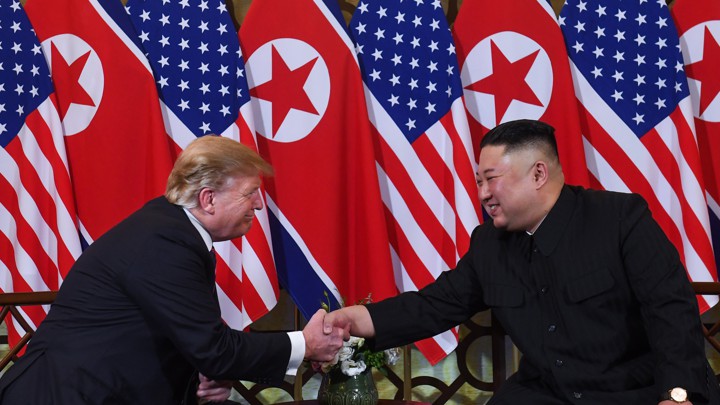
The diplomatic stalemate with North Korea continues. From June 2018 through April 2019, the absence of diplomatic progress between Washington and Pyongyang wasn’t too worrisome. Sure, the heady optimism of the Singapore summit was fading, particularly after the “failed” Hanoi summit, but there were still glimmers of hope. Kim Jong Un and Donald Trump had a good relationship. North Korea ceased nuclear and missile tests. Perhaps both sides were simply taking a breather, a respite, before getting down to the business of substantive talks. 

Unfortunately, that hasn’t turned out. Since Hanoi, North Korean-US diplomacy has gone off track. At this point, there is zero discussion between the American and North Korean “working teams.” This means, then, talks are at a standstill since Hanoi.

If you recall, the Hanoi summit broke down without any diplomatic agreement or even a joint statement. The North Koreans were willing to shutter bits and pieces of its program in exchange for some sanctions relief. The US rejected the North Korean proposal, arguing that it wouldn’t offer any sanctions relief until the Kim regime scrapped entirely its nuclear program. There was some hope, particularly among the South Koreans, that Trump was merely posturing, trying to get more bargaining leverage, and that he would eventually change his mind and pursue a more modest bargain. That hasn’t happened yet.

Indeed, the way the Hanoi summit unfolded, with Trump declining North Korea’s offer and abruptly ending talks, has turned out to be a big deal. It shocked Kim and his aides. And, as it turns out, angered him as well. So angry was Kim that recent reports indicated he executed five senior officials, squarely placing the blame on them for the lack of a diplomatic breakthrough with the US. However, whether Kim actually had these five officials killed is the subject of an ongoing debate. Already, one of the five (Kim Yong-chol) has been spotted on North Korean media. It is plausible that Kim wanted news of his ruthlessness leaked in order to communicate—both to his cadre of officials and to the US—his displeasure with the pace and direction of the talks with the Americans.

Another powerful sign that Kim is currently unhappy with the US is that North Korea has resumed missile launches in May (May 4th and 9th). Fortunately, the two tests weren’t ICBMs, which gave the Trump administration enough wiggle room to downplay their significance. Indeed, both Secretary of State Mike Pompeo and President Trump argued that the short-range tests by North Korea were fine—despite their violating UN Security Council resolutions—it’s the long-range rockets that they’d find provocative.

The good part of minimizing the severity of the tests is that Team Trump didn’t feel forced to counter Kim with retaliatory, escalatory moves. The ominous part, though, is that it’s clear Kim is frustrated with the US. The crux of the matter, I suspect, is that Kim expected to receive more tangible benefits as a result of two meetings with Trump. And at this point, the relationship with Washington hasn’t fundamentally changed. The status quo has held. The relationship hasn’t been normalized; sanctions are still intact; and the US still monitors smuggling and other efforts to circumvent sanctions—including the recent seizure of a North Korean vessel. At bottom, the US still has its foot on the metaphorical throat of the Kim regime.

To his credit, Trump hasn’t inflamed the situation. Among other things, he’s refrained from criticizing or threatening North Korea. In fact, he’s gone out of his way to praise Kim—something that’s triggered significant blowback from American media and analysts. Trump has also maintained the shift toward smaller military exercises with South Korea. In an effort to alleviate pressure on Kim, Trump has even stated that he’s in no rush to get a deal done with North Korea

Where do we go from here? Unfortunately, Trump has unintentionally isolated himself. By moving so quickly to an in-person meeting with Kim last June, and then again this past February in Hanoi, it’s pretty evident that Kim wants little to do with Trump’s negotiating teams. North Korea state media constantly demonizes Pompeo and Bolton, signaling that Kim sees them as personae non grata. Kim seeks only to deal directly with Trump. So the onus is on Trump to reassert forward progress. That’s not an optimal way to conduct foreign policy. US foreign policy—an issue that requires deep experience and expertise—shouldn’t be a one-man show. Plus, Trump is likely to be a distracted president over the next 16 or so months, given US domestic politics. He’ll have little time or patience to devote to intractable issue like North Korea.

Of course, all of this begs a big question: What if Kim believes he’s not receiving what he thinks is the appropriate level of attention from a preoccupied Trump? This is where things could quickly go haywire. Kim could do any of a number of provocative acts, including resuming nuclear and ICBM tests, so as to place him on Trump’s, and the world’s, radar. If that happens, we could be back in the “fire and fury” days of 2017.

To avoid a repeat of those times, I have two recommendations. First, Trump ought to try to convince Kim and his lead negotiators to take the American delegation, led by US representative to North Korea Stephen Biegun, much more seriously. Beigun isn’t Bolton or Pompeo, doesn’t seem like a hawk, and so there’s little reason to fear him. Plus, this would allow the US and North Korea, working diligently behind the scenes and away from public attention, to flesh out areas of common interests and the kind and scope of concessions each side is prepared to make—things that Trump and Kim are unlikely to finalize in a one or two day summit. If an insecure and desperate Kim wants face time with Trump, then Trump should give him a summit or two, as long as the working teams are meeting and making some progress on salient bilateral issues.

Second, Trump needs to scrap his “go big or go home” approach to North Korea. The American quest to achieve its maximal desired outcome (which is still CVID or a variation of it) just isn’t working. After all, North Korea just isn’t willing, and it probably will never be willing, to shutter completely and irreversibly its nuclear program. But given the reports on the Hanoi summit, Kim does seem willing to bargain over parts of it. Instead of looking at this as a sign of Kim’s intransigence, as Bolton and Pompeo do, the US should see this as a possible window of opportunity. Trump’s team should be prepared to negotiate with Kim on a proposal built around freezing/verifying/dismantling parts of Kim’s nuclear program (facilities, nuclear material, technology, weapons, etc.). Start small, build mutual confidence in each other, and then move to more ambitious cooperation.

Wednesday, May 8, 2019

Turmoil in Venezuela


Image result for guaido
Opposition leaders Juan Guaidó and Leopoldo Lopez address a crowd in Caracas on April 30, 2019. EPA: Miguel Gutierrez.


The much-hyped coup in Venezuela hasn’t come to pass. Nicolás Maduro has been more tenacious and his grip on power more durable than many observers have expected.

Rival leader Juan Guaidó, head of the National Assembly, has raised global hopes for a transition in power, but so far hasn’t been able to capitalize on the external support he has from widespread support in the Americas, including from the Trump administration. Simply declaring himself president, because the previous presidential elections were rigged, wasn’t enough to budge Maduro from power. Guaidó has attempted to woo Venezuelan citizens, elites, and members of the military to his side, but wooing all of these different actors has been difficult. While Maduro is despised, citizens are wary of Guaidó—his motives, interests, and capabilities as a leader. And they surely haven’t embraced Guaidó enough to get out into the streets en masse.

There have been some elite and military defections, but not enough to swing the internal balance of power to Guaidó’s advantage. It’s clear that Guaidó believed he had significant military support last week, when he called for uprising against Maduro. But lacking military support and numbers on the streets, his attempted putsch went nowhere. Instead, Maduro quickly and easily put down the few thousands of Venezuelans who responded to Guaidó’s call.

It’s apparent that Maduro is walking a tightrope. He clearly wants to preserve his grip on power. At the same time, though, he knows there are limits on the extent to which he can ask military and security forces to repress the political opposition. After all, he hasn’t gone after Guaidó, which he could have done already. And the street battles haven’t been particularly bloody, despite international worries the country could slide into a full-fledged civil war. The reason for these realities is that Maduro knows he can’t make dramatic, hyper-aggressive moves, such as asking his forces to shoot their fellow countrymen/women, because they could result in a wave of negative cascading effects. Indeed, one is the prospect that the military could fully break with Maduro, leaving him vulnerable to being toppled, arrested, or even losing his life. 

Beyond the Guaidó-Maduro battle for power, there’s another power dynamic in play here: the US and Russian battle for influence in the Western Hemisphere. The US sees Venezuela as part of its backyard and thus a part of its sphere of influence. In line with the long-accepted Monroe doctrine, the US wants all foreign powers out of the Western Hemisphere—demands with which Russia and China are not complying. Russia, meantime, has a host of political, military, and economic interests at stake in backing Maduro. Moscow worries about what might happen to its array of investments in Venezuela if Maduro is washed aside and a different figure, let alone a reformer, rises to the top. Plus, Russia sees the ongoing crisis in Venezuela as a vehicle to get the US bogged down in its own neighborhood, thereby preventing Washington from meddling in affairs abroad, particularly in Russia’s backyard.

How this plays out remains to be seen. The optimal solution is to guide Maduro peacefully out of office—either immediately or via a phased transition—making way for free and fair democratic elections. It’s what best for Venezuelans, who desperately want and need new and improved leadership. The country is less free, wealthy, and stable on his watch. The puzzle, of course, is how to get to that point.

Up to this point, the US has hoped that recognizing Guaidó, squeezing Maduro’s oil funds, and refusing to rule out a military intervention will do the trick. Combined, all of these things have certainly upped the ante for Maduro, but they haven’t eased him out of power yet. And Guaidó hasn’t helped matters with his ill-timed attempted coup. What’s needed is a clever approach that changes the incentives that Maduro and his senior level cadres currently have about supporting the political status quo.

According to the Washington Post, Venezuela’s political opposition is trying to do precisely that by presenting Maduro loyalists a combination of sticks (rejoining the Rio Treaty) and carrots (the prospect of joining a transitional government). Concurrently, the opposition is engaged in diplomatic talks with a host of international actors, including the global powers and various international institutions. All of this is a good start, though more is needed. Below I briefly suggest a few more things the opposition ought to consider.  

First, the opposition must recognize that allowing Maduro and his cabal to exit the corridors of power with some level of face or prestige intact is one potential concession it may have to make. Yes, that will be a tough pill to swallow for some of the opposition, but it might be necessary. Put simply, if Maduro believes he doesn’t have a safe exit option, then, by default, he’ll cling to power for self-preservation purposes.  

Second, I’d advise the opposition to tend toward inclusivity. This is controversial, however. Some opposition members are firmly against allowing any of Maduro’s cadre, especially the very people responsible for Venezuela’s plight, a continued role in politics. That’s understandable. But drawing in the middle and lower strata of Maduro’s circle might be possible, and shouldn’t be ruled out. Look, there’s already bad blood between Chavez and Maduro backers and supporters and the opposition; the key now is to try to find ways to dampen those tensions over both the short- and long-term. Creating an environment that’s palatable to, perhaps, the outer rungs of the old guard is a good thing: it can pave the way for all sides to build trust, create a stake in the changing political system, and move on from the past and look toward the future.

To be clear, in the two arguments above, I’m not suggesting that the opposition should give, without hesitation, Maduro and his acolytes a blanket clean slate. Of course, a new Venezuelan government should be guided by the rule of law. But this government will have to make hard decisions. And in the long-run, it might be best for the nation if some of the old guard are mostly left alone and permitted to retire in peace or allowed to defect to another country, rather than seeking retribution through the courts. The latter route, while maybe legally sensible, risks opening up and deepening existing political fissures in a nation that’s already fragile, unstable, and trending toward violence. 

Third, Guaidó will have to convince the major external players, like Cuba and Russia and the US, that their interests won’t be significantly jeopardized with a new government/regime. Yes, the US will be on board with what seems to be a reform-minded government, though, even here, Guaidó will have to sync his positions and policies with those of the Trump administration. After all, the White House is the biggest and most vigorous international backer he has right now. Cuba and Russia are a different story. Both countries receive considerable political and economic benefits from Venezuela as it currently operates. They will need, at a minimum, a clear statement of how they fit into a Guaidó administration’s plans and reassurance that they won’t be significantly adversely impacted if Maduro leaves/is toppled. Otherwise, Guaidó should expect stiff resistance from Cuba and Russia, and both will undermine his rule until he plays nice with them.  

The above suggestions aren't the only things Guaidó should do right now. I've simply identified some of the most important immediate tasks in order for him and the opposition to ease Maduro out of power. Keep in mind we're witnessing the first stages in a very long game. For even if Guaidó is successful, the problems and complexities don't end there. An entirely new set of governing challenges will emerge. And those are bound to test even the most astute political leaders. Let's hope that Guaidó, or whomever next takes the reins of power, is ready for the moment.

Friday, April 19, 2019

The Mueller Report


Photo: Robert Mueller/Getty Images

Yesterday, at long last, after almost two years of investigations, the Mueller Report was finally released. Although the Mueller investigation and his report are now done, the fallout of the Russian election meddling and President Trump's suspect behavior continues. Why? Put simply, while Trump denies it, the report, while not finding evidence of criminal collusion, or conspiracy, does make a strong case for obstruction of justice. In other words, did Trump, or his surrogates, try to engage in a cover-up? Did he (or they, at his request) hinder the ongoing investigation? The verdict? The report explicitly states that it does not exonerate trump for such misdeeds. Based on the report, The Washington Post has highlighted 10 (10!) instances of possible obstruction of justice. Despite all of that, Robert Mueller and his team have left it to Congress to sort out whether Trump obstructed justice and whether to punish Trump if such acts took place.

Trump argues that if no collusion took place, then there’s nothing to obstruct. His political opponents disagree, and they do have a case to be made. Sure, Mueller didn’t find strong enough evidence of obstruction to take a position, but that’s a separate matter from how Trump acted in response to the investigations. He still could have tried to scuttle the investigations—either by getting rid of Mueller and his team or making life difficult for them. And there’s evidence, if you’ve read the report, that Trump attempted to do both. Frankly, probably the only reason Trump didn’t overtly obstruct justice is because some of his staff, like Don McGahn and Rob Porter, declined to do things they knew were extraordinarily shady if not outright illegal. 

Of course, all of this begs a question: Why would Trump attempt to obstruct justice? That’s long been a puzzle, based on a list of things we’ve already known (firings of James Comey and Jeff Sessions, badmouthing Mueller and his team of “angry democrats,” constantly deflecting attention to “Hillary’s emails,” etc.) Logically, it seems that either Trump mistakenly believed he acted illegally, or actually did act illegally and Mueller simply couldn’t pin down his “crimes and misdemeanors.” Whichever the case, Trump believed his presidency was in big trouble. After all, after getting word of the appointment of Robert Mueller as Special Counsel, Trump reportedly said, “Oh my God. This is terrible. This is the end of my Presidency. I'm fucked.” This wasn't a guy who thought he was innocent, no matter how much he declared otherwise on Twitter, at his rallies, and elsewhere.

Because the metaphorical ball has been tossed to Congress, the proceedings are no longer a legal matter and are now a political one. Which means that, because of the deeply polarized electorate and legislature, deciphering the meaning of the report is a partisan affair. Democrats are lining up to pillory trump; the Republicans are largely standing behind Trump, seemingly content with Trump’s labeling of the multi-year investigation as a “witch hunt.”

Democrats now have a decision to make. Do they want to go forward and make the case for impeachment—or not? This question is complicated by the upcoming presidential election in November 2020. A few Democratic candidates, like Elizabeth Warren and Beto O’Rourke, have admitted that they’ve only received a few questions about the investigations on the campaign trail, a sign the democratic base is less interested in this sordid affair than in basic democratic concerns (health care, income inequality, climate change, etc.). Moreover, there is no evidence that the Senate would vote to convict trump on impeachment, so impeachment proceedings, in the end, would be mostly symbolic. It would be a gut move to mollify the democratic base.

Additionally, most Americans, at least to this point, don’t support impeaching Trump. Yes, the political left does, but most Americans don't. So going the impeachment route carries big risks. Specifically, an electorate that's tired of investigations could punish the Democrats for overreaching in their efforts to remove Trump from office. And that could result in the Democrats losing the upcoming presidential race and also the House, which they just won in 2018.

My educated guess is that the Democrats won’t move en masse on impeachment. We will probably see a few push for it, and already Elizabeth Warren has called for the House to begin impeachment proceedings. But it's a very risky move. Mostly, they will use the Mueller report as talking points to hammer Trump and the Republicans and to galvanize their base. In the meantime, though, political polarization will continue to widen and harden in the US. Trump won't take his "win" and let the rest go. He will press the case that he was unfairly targeted by crazed Democrats who seek to destroy Trump and all of MAGA's supposed achievements. And that, in turn, only gins up further Trump's rabid base of supporters. And with the 2020 elections around the corner, this makes for a combustible, toxic political brew. Overall, I fully expect turbulent political times in the US will remain a fixture and possibly worsen as we head toward November 2020.