Center for World Conflict and Peace

Center for World Conflict and Peace

Thursday, October 20, 2011

Occupy Wall Street

Image Detail


The Occupy Wall Street (OWS) protests are now five weeks old. They have mushroomed from the OWS home base in New York to dozens of cities across the U.S. and overseas.

At first, media coverage of OWS was sparse, likely because many outlets thought the protests would quickly lose steam and fade away. Discussions about OWS were mostly confined to Facebook, Twitter, and blogs. But by now, OWS has gone mainstream, entering popular newspapers and network and cable news shows, though a considerable amount of this coverage has been filtered through partisan politics.

Many conservatives mock the protesters. House Majority Leader Eric Cantor called the protesters a "mob." Republican presidential candidate Herman Cain has said that the protesters shouldn't blame others, including Wall Street, for their plight. Instead, they ought to buck up, take some responsibility, and find jobs. Overall, conservatives see the OWS crowd as misguided, lazy, entitled, troublemaking class warriors who lack a coherent message that details their grievances. Often, conservatives paint the OWS protesters as middle class hippies who want an extension of the welfare state, especially government hand-outs. Defined in this way, the OWS protesters are their political foe.  

In general, liberals have embraced OWS. They see a nascent message, if not in the words and posters of the demonstrators, then certainly in the simple act of gathering and protesting against big business. The protesters, as well as their sympathizers, claim that big banks, large corporations, wealthy financiers, and big money are having pernicious effects on the U.S. In particular, these things are harming American democracy, raising income inequalities, and destroying the idea of social/economic mobility. And Democrats are now trying to co-opt OWS, believing that they might be the left's answer to the Tea Party, a populist, bottom-up movement that's packed quite a political punch on the American political landscape.  

At bottom, OWS is rooted in anger and frustration with banks, big business and corporate bailouts, mixed with inspiration from the Arab Spring. In fact, the OWS protesters see themselves as following in the footsteps of the protesters in Egypt, Tunisia, and elsewhere in the Middle East. As evidence, take a look at the OWS web site. Moreover, look at the actions and structure of OWS, which resembles the Arab Spring protest movements. The OWS movement is leaderless, almost deliberately so, employs peaceful civil protest tactics, and uses social media tools to organize, galvanize further support, and communicate with followers.  

At this point it's too soon to make definitive conclusions about OWS, despite the hue and cry from its supporters and detractors. Think about it, this is still a very nascent movement, and much could still go right or wrong for it in the coming days and weeks and months ahead. In the meantime, here's a few preliminary questions and observations to think about.

1. Isn't the civic engagement of OWS a good thing?

Yes, more participation and activism in American politics is a good thing, even if it's in the form of peaceful protest. It's healthy, even vital, when minorities seek to defend their interests and denounce perceived injustices. It's all a part of the process of thwarting tyrannies of the majority, which can occur even in democracies, especially majoritarian presidential democracies that funnel political power into a limited number of groups and people. Additionally, the OWS protests can widen the political discourse, adding new political narratives that to an arena that's dominated by the famous and powerful and wealthy. They might bring new ideas to the table that later get absorbed into political debates and policies. For instance, Nick Kristof of the New York Times hopes that the protestors' emphasis on dealing with rising income inequalities makes it into  the"national agenda" and a part of the 2012 election campaign. And lastly, based on reports, while the OWS protesters might be best categorized as part of the "far left," they are not extremists and they're not violent. There's no reason they shouldn't be heard from.

2. Will OWS become a political force in U.S. politics?

On the one hand, OWS is already plagued by organizational dilemmas. There have been reports of internal divisions. The protesters have been unable to come to a consensus on important items, such as which issues to focus on. But that's not all. The protesters also disagree over the small stuff, like whether sleeping bags should be brought into Zuccotti Park or how to limit the infamous and noisy bongo drum playing. And OWS lacks central leadership and a camera-ready message ready for broadcast to the public. These two problems are related. Without effective leadership, which could implement coherent and consistent messaging, the protesters freelance and improvise when speaking to reporters and journalists. The result? The American public has heard dozens of different messages, which creates confusion likely inside and outside of the movement, hinders its ability to grow support, and makes it easy to lampoon. Even late-night comedians have remarked that protesters have "occupied" Wall Street, but few protesters know why they're there or what they're doing. Viewed in this way, OWS has a long way to go before its a meaningful player in U.S. politics.

On the other hand, one could claim that this is the next phase of the young left fully mobilizing and interjecting itself into American politics. But unlike the energetic youth who campaigned for Howard Dean in 2004 and Barack Obama in 2008 and fueled the popularity of web sites like Daily Kos and MoveOn.org, and who maintained a commitment to the democratic party and its institutions, perhaps this is something different. Peter Beinart contends that "today’s Wall Street protests represent the left’s decoupling from ObamaBeinart's argument recalls the left of the 1960s, which actively and forcefully took on establishment Democrats, including the sitting president, on issues such as civil rights, poverty, and war, and was a potent political force. Although I'm skeptical that OWS will have anywhere near the impact of its ideological ancestors, it's certainly a provocative take and something to watch going forward.

3. Is OWS a transnational movement?

The American demonstrations on October 15 picked up substantial support from abroad, as protests from the States spread to various cities in Canada, Europe, and Asia-Pacific. Surely, the foreign protesters are disenchanted with big banks and and big business, and they have tapped into the emotions and frustrations and unleashed by OWS, though the circumstances are slightly different from those in the U.S. For instance, some of the protests in Europe were in response to deep austerity cuts, which governments have had to make to balance their books.

The OWS protesters in New York have begun coordinating with their counterparts in other American cities. I wonder if OWS will build bridges to the foreign demonstrators, making the protests a truly transnational effort. Should that happen, we might see both sides working together in different capacities, including but not limited to: the formation of communication linkages, information sharing, fund raising, issue messaging, protest action, and so on. Together, the protesters in the States and overseas could create the kind of transnational networks that Anne-Marie Slaughter has touted as so prominent in contemporary world politics.

Of course, it's also possible, perhaps probable, that the foreign protests were simply an expression of like-mindedness and sympathy for OWS, and that there's no further connection between the American and overseas protests. After all, just because there's shared anger at some of the same things, this certainly doesn't mean the two sides will work in concert together. Organizational problems (for the American and foreign protesters) could act as obstacles to collective action. Both sides might not want to work together. And there might be enough different issues at play that protesters on opposite sides of the Atlantic consider their struggles too unique for much collaboration.

4. Will OWS succeed or fail?

This could be a difficult question to answer, particularly if one believes there's no demonstrable way to measure the progress of OWS. Right now, someone need not be a critic of OWS to see the movement as extremely amorphous. But for the sake of argument, let's say that it is possible to track the success or failure of OWS. In fact, let's look at the progress of OWS in a very general sense: Will OWS make an impact on the American political landscape?

First, OWS will have to manage its image. This is an important consideration for OWS. There are a number of different ways in which its name can be sullied, all of which would erode any political power it's accumulated over time. Should OWS find its power markedly diminished, the movement can rule out having much of an impact on American politics.

Most obviously, OWS will have to resist any temptation to fight or use force, even if the protesters have been unjustifiably provoked and harassed. Violence plays right into the hands of those who think of OWS as extremists and radicals, turns off sympathizers, and probably even peels away some of the peaceniks who are presently involved OWS.

OWS will also have to monitor continually how the public perceives and reacts to the protests, especially if they endure well into the future. This is a lesson OWS could learn from the Arab Spring. After the fall of Mubarak, the Egyptian revolutionaries continued to hold rallies and protests of various sizes, usually decrying some statement or action by the ruling military council. But once Mubarak fell from power, many Egyptians lost their revolutionary fervor and wanted life to return to normal. They had enough of the protests. Why? The protests, especially the large-scale ones in Tahrir Square, disrupted traffic, shopping, and other daily activities. At this point, the revolutionaries risked losing widespread support, even if their causes were just and popular. As a result, pro-democracy movements like April 6 had to more judiciously pick and choose select times and issues to engage in mass protest. OWS might face a similar situation, whereby American citizens eventually get fed up with the acts of protest, regardless of what they think of Wall Street. In this case, OWS would be better served to scale back its public demonstrations and call for mass protests only on specific occasions.

Furthermore, yes, OWS enjoys some popularity among Americans, but the longer there is no message, no concrete ideas, and no visible leadership, the negative press (that the OWS crowd are lazy, entitled, radicals, etc.) from the right will likely stick and eat at this popularity. More to the point, without a clear voice from the OWS protesters, the right will write a narrative for them. It's only a matter of time unless OWS fairly quickly coalesces into a more unified functioning movement.

Another issue is the structure of America's democratic system, which channels money and power into two political parties. The barriers to enter U.S. politics as an independent entity are extremely high. And so for now, OWS's best prospect for success is to get co-opted by the Democrats, who can more forcefully advocate on the behalf of OWS. And once there, in the Democratic fold, perhaps OWS might have just enough leverage to force the Democrats to make changes it desires inside the party (policy positions, candidates, etc.).

By the way, this is exactly what happened to the Tea Party. It began as a movement to hold all of Washington--both Democrats and Republicans--accountable for America's current political and economic woes. But the ideological leaning of its members, in combination with lobbying efforts from the establishment right, has brought most of the Tea Party into the Republican camp. And from inside the Republican tent, the Tea Party has found enough temerity and power to challenge conservatives on a number of things, even going so far as to put up and support its preferred candidates for elected office over those of the establishment right.

Friday, October 14, 2011

Alliances, Bandwagoning, and Asia

I recently came across a rather curious blog post by Stephen Walt, esteemed professor at Harvard's JFK school of government. Apparently, Walt traveled to South Korea for a conference on security affairs in Asia. In his blog post, he copied a portion of a paper he presented at the conference. The content of this paper should be very familiar to international relations students and scholars. For those who aren't aware of Stephen Walt or his work, I'll give some brief background information on both.    

Walt has made his name by challenging balance of power (BOP) theory, arguably the dominant theory in security studies scholarship, with his own balance of threat (BOT) theory (see his most famous work Origins of Alliances, which covers these theoretical debates). Both theories address alliance formation and patterns--that is, when countries form military alliances with others for their own self-defense--but the force that triggers such alliances differs in the two theories. Walt contends that countries don't simply balance (or align) against other powerful countries (which is what BOP theorists claim), but against threatening or menacing countries. In Walt's formulation, "threat" is a broader category than power, as it incorporates power, yes, but also geographic proximity, political intentions, and offensive power projection capabilities. So using Walt's BOT theory as a guide, it's no surprise that powerful countries like China are seen as threatening to others in the international system. But additionally, it should also be no surprise that countries like Iran and North Korea are labeled threats, since they are perceived by many (including the West, Sunni countries in the ME, etc.) as harboring aggressive, malign intentions to harm global and regional peace and stability. In general, Walt believes balancing rules the day in international relations, as states are presumed to be defensive security seekers most concerned about protecting their interests and values from potential threats. 

Now, back to Walt's blog post. I'd like to direct your attention to two quotes that focus on the concept of bandwagoning, which is another type of alliance. In bandwagoning, just as the term connotes in everyday parlance, countries align themselves with (not against) the dominant power or the source of the threat. They don't aim to oppose, or block, or thwart the dominant power or threat.

(For clarification, please keep in mind that Walt's blog post focuses on regional alliances in Asia. And currently, because of its growing military and economic power, it's increased foreign policy assertiveness, and its geographic location, China is seen as the looming danger or threat in Asia. It's the country that others in the region are going to have to decide whether they want to side with (bandwagon) or against (balance).)

Quote 1. "In rare cases, weak or isolated states may be forced to 'bandwagon' with a powerful state. Weak states can do little to affect the outcome of a great power contest and may suffer grievously in the process, so they must choose the side they believe is most likely to win. They may be willing to stand up to a stronger power if they are assured of ample allied support, but a weak state left to its own devices may have little choice but to kowtow to a larger and stronger neighbor. That is how 'spheres of influence' are born."

Quote 2. "As I've noted before, a third challenge is the question of how much support the United States has to provide its Asian partners in order to keep them on board. If Washington does too little, some of them might be tempted to cut a deal with Beijing."

Notice anything strange about these two quotes?

In the first quote, in which he outlines his theoretical definition of bandwagoning, Walt argues that countries side or align with the threat because they face heavy coercive pressure from a more powerful rival or opponent. In other words, countries are bullied into bandwagoning behavior. They have little choice but to capitulate to the whims of their stronger, more feared opponent, which seeks to expand its influence over them, because confronting it head-on carries grave risks.

But in the second quote, in which he filters his theoretical discussion through various hypotheticals about Asian politics, Walt defines bandwagoning much differently. Here, countries bandwagon with the threat so as to gain something tangible from the relationship. After all, look at the context of the second quote. There's no mention of bullying. Instead, it's all about whether the U.S. keeps Asian countries "on board" or declines or fails to do so, letting them flee to China for a better deal. Essentially, this is a bidding war. It comes down to whether the U.S. can pony up enough to keep Asian countries satisfied and in its camp. But wait a minute, that's something that doesn't activate bandwagoning, right? I thought bandwagoning occurs when one side, presumably the weaker one, is coerced into joining the powerful/threatening side.

The logic is stunningly inconsistent, especially for such a prominent academic.

Here is the issue: Walt continues to ignore a major theoretical criticism launched against him by Randall Schweller, in his 1994 journal article "Bandwagoning for Profit." Schweller (my mentor, just to be clear) argues that Walt unnecessarily restricts the definition of bandwagoning by equating this form of alliance with coercion and bullying. He believes that Walt overlooks that bandwagoning can occur for reasons related to greed and power maximization. As evidence, Schweller cites a slew of examples, including the behavior of Italy and Japan in World War II, both of which aligned with the Axis powers to share in the spoils of victory. Relatedly, he writes, "Stalin's eagerness to fight Japan in 1945 was driven more by the prospect of gaining unearned spoils than a desire for greater security from the United States or Japan" (p. 82). And the logic of bandwagoning pervaded cold war politics for both the Americans and Soviets, with both sides fearing that should the other one gain power preponderance, it would serve as a magnet to attract other countries into their camp. Schweller argues that bandwagoning has continued into the post-cold war period, animating such conflicts as the first Persian Gulf War.

By ignoring these critiques, Walt conceptually defines bandwagoning just as he has for the past 25 years. Yet when he dives into his discussion of Asian politics (which is where the second quote was pulled), when he starts to project what might happen in the region, he then has to face the hard realities that some countries might side with China, though not because China threatened or bullied them, but because they believe they can gain from the relationship. Hence, we see the logical disconnection between quotes one and two.

Of course, it's also possible that Walt just doesn't see "cutting a deal" with China as representative of bandwagoning. Perhaps he envisages it as something less than flipping sides, perhaps, say, a deal to remain neutral. It's possible, which then does preserve some sense of logical consistency. But here again, there are problems. As mentioned above, at least without any further clarification, "cutting a deal" reads as if Asian countries are indeed switching sides, moving from the American to the Chinese bloc. Moreover, I'm not convinced that Beijing would be willing to make a deal with a nearby country, especially one in which China offers an array of concessions and perks, and let it remain outside of China's orbit. China will want more bang for it's buck.

What do our readers think? Any reactions?

Tuesday, October 11, 2011

Egypt Part Deux


Here's a quick reaction in responses to interesting news updates on Egypt in the past few days.

The New York Times' Robert Mackey noted the importance of the social media in challenging the official narrative of the violent events, in essence providing the voice to the oppressed and their unofficial and underground narrative.

It is interesting to observe how the Egyptian officials initially reverted back to how the state operated during the days of Mubarak, squelching the voice of dissenters and using the official media to split the opposition by wrongly claiming that it was the Coptic Christians who provoked the violence.

The coverage of the state's news media is now under a harsh spotlight. The state-run Channel One TV host Rasha Magdy's hate-mongering and religion-baiting, which served to incite the population to attack the Copts, led to many condemnations from even within the Channel One itself.

On Tuesday, the Egyptian government did an about-face. The government declared that it would launch a probe on the unrest and would try to address many of the Copts' grievances. Whether this is just a ploy, simply some soothing rhetoric and then back to business-as-usual, remains to be seen.

Still, the fact that it took one riot that cost more than twenty lives and lots of negative international attention in order to spur the government to do something signals that something is wrong with Egypt. Indeed, the events beg the following questions: What if the Salafis launched massive demonstrations? Would the government protect them, preferring not to inflame Egypt's Muslim population? Or would it crack down on them, just like did to the Copts?

The riot in Egypt also shows the advantages and limitations of social media tools. Social media are useful in order to get information out as soon as possible, which can do a number of things, such as galvanizing support for causes, disseminating counter-narratives, and so on. At the same time, we also need to recognize the fact that, in the Egypt case, the counter-narrative had to be sent abroad, to non-Egyptian media, in order to make an impact (i.e. international pressure), because the military had stormed (and controlled) news outlets in Cairo during the protest and quashed any evidence of its brutality.

Here, social media could not be used to make a "Hollywood Ending," where a set of words and images are smuggled into a news station, the brave personnel broadcast them, thereby mobilizing the masses, to end the violence and state's brutality upon its population. Social media could not save the day on its own. Social media is becoming an increasingly important tool of communication and organization, but it's ultimate utility is often circumscribed by other, more important factors.

Monday, October 10, 2011

The Collapse of Arab Spring?

Egyptian Coptic Christians hold up a blood streaked cloth after a clash with soldiers and anti-riot police (AFP)


It might be too early to declare the death of the Arab Spring. From the perspective of history, ten months is a relatively short time frame. Zhou Enlai, the late Prime Minister of China, was famous for his quip, "it is too soon to say," when he was asked about the impact of the French Revolution. (Incidentally, this caused another debate, whether he meant the 1789 revolution or the 1968 student revolution).

One thing that's for sure, however, is that in the short-term, the revolutions are not going according to what many liberal reformers expected back in the euphoric days following the fall of Ben Ali and Hosni Mubarak.

Both Brad and I have devoted several posts already to the Arab Spring, some of which warned about the possibilities of the Egyptian Revolution spiraling out of control. Brad warned about the the need to immediately deal with political and security troubles before they spiral out of control, though overall he was optimistic on the future of Egyptian democracy. As a prophet of doom (which, I think, is my job description in this institution), I noted the possibility of an alliance of expedience between religious extremists, who seek legislative power, and the military, which wants to maintain its role as the main power broker and its access to a wealth of economic perks.

The recent religious clashes seem to confirm my worst prediction. We should blame the military government for appearing unconcerned about the growing assertiveness of the Islamic fundamentalists who've threatened the security of both the moderate Moslems and the Coptics. (EDIT: it has been established that the military was entirely at fault in provoking the violence)

So what has went wrong (so far)?

1. The military really isn't operating with the country's best interests in mind. Instead of trying to impose order so as to secure the survival of the Egyptian state, the military prefers to stay outside of the fray, believing that's the optimal way to not to antagonize most Egyptians, including the extremists. This is the military's tactic to maintain its political and economic interests. This explains the attacks on the Israeli embassy in Egypt and the military's unwillingness to tackle the anti-Christian provocations.

2. At this point, there is no alternative to the Moslem Brotherhood and other Islamist organizations and parties. While many have touted the "Facebook Revolution" of the Arab Spring as a "new" concept of effective policy-making, the case of Egypt shows the limitation of such social media-led revolutions. When confronted by determined, in some cases violent, opponents, who have the backing of strong and better organized state organizations and institutions, the "revolution" fizzled. The revolutionaries have been unable to mobilize an alternative political vehicle, and the only way that changes is if they are co-opted by the established political elites or organizations.

In fact, the "Facebook Revolution" only happened because everyone in Tahrir Square was united by a single goal, which was the fall of the House of Mubarak. This established a common goal, a catch-all platform that appealed to anyone from the far to the left. Once Mubarak was ousted, and time revealed everyone's true divergent interests, then the platform, the facade of unity, was shattered.

In essence, the revolutionaries biggest problem is in developing their own strong organizational power structure that has coherent and detailed sets of propositions that might be used as a foundation for new laws, a constitution, and eventually electoral support. Students of history would be wise to look at the days before and after the resignation of President Suharto back in 1998.

3. The moderates' voices were silenced. This is partly influenced by the second factor I just mentioned above. Another reason is that some of them have been silenced by choice. That is to say, many prefer to work behind the scenes, beyond the glare of media attention. Additionally, some moderates have been coercively silenced, through threats from local groups and people looking to forestall if not outright prevent significant political change. All of this suggests that the country's atmosphere has turned ugly and chilling for the voices of moderates.

Going forward, if the Egyptian government/political elites are truly interested in creating a strong pluralistic society, which is the basis of a modern nation-state, it needs to act decisively in quelling the current troubles. They should no longer tolerate any discrimination and ought to guarantee equal rights and protection under the law for everyone. "Protection under Sharia" is not an answer, as by default, the Coptic community will be rendered second-class citizens.

Egypt must also bring those responsible for stoking the violence to justice, regardless of whether the person is a Coptic or a soldier or an Islamist. The next few months will be critical moments that will determine whether Egypt will survive as a modern nation or end up as another dysfunctional nation with a dim future.

Sunday, October 9, 2011

Power Shift? Or a Failed Power Transition?

Image Detail


For about the last 15 years, much has been written about the so-called rise of China. Of these writings, a significant chunk has treated China's ascension as inevitable, a foregone conclusion. Put simply, given current power trends, especially economic and military power, many who study and observe world politics believe that China will one day shortly in the future rise up the great power ladder. The world will witness a power shift, from West to East, whereby the current unipolar international system led by America will morph into a bipolar (and possibly multipolar) one led by both the U.S. and China, with China eventually becoming the lead dominant power. To these writers, the rise of China is a specific, contemporary example of a recurring historical phenomena--that is, the rise and fall of great powers over time--and something that's unfolding before our eyes right now. 

This literature includes the writings by a number of scholars, such as Stephen Walt and Christopher Layne, and political pundits and journalists, such as Fareed Zakaria and Gideon Rachman. Zakaria has tried to finesse the issue of China's rise by claiming his work focuses mostly on the rise of emerging world powers like India and China, not the decline of the U.S. But given that he titled his most recent book "The Post-American World," it's clear where he stands on this topic.

For now, let's take a deep breath. In some ways, we've heard these fears and worries before. Indeed, they are reminiscent of the fears about cold war Soviet Union and late 1980s/early 90s Japan. Today, the chattering class is sounding the alarm bells about China. New decade, new fears about a looming threat from another part of the world.

To be sure, China has lots going for it. For the past 30 years, it's economy has been astounding, it's prolonged double-digit growth unprecedented. The country has made steady improvements and advancements in its military. And of course, China has embarked on a build-up of its military, especially regarding its power projection capabilities directed at Taiwan. China is an emerging hub for new technologies, especially green technologies. With several recent maritime disputes and diplomatic clashes with countries in East Asia, it's evident that China is becoming more assertive, and at times aggressive, in pursuing its interests in the region. Which is a clear sign that its leadership recognizes that the country possesses the power base to defend if not expand its interests.

But all of that doesn't necessarily mean China will catch up and surpass the U.S. in the global power game. Here are a few concerns. China's economy could overheat. Its economy can't continue to grow at 10% for the foreseeable future, right? After all, it's an export-led market that depends on a healthy and vibrant U.S. and European economies, China's two largest markets, and both are struggling and expected to struggle for the next several years. Economists have long suspected that the unemployment rates in China are far higher than what Chinese bureaucrats routinely report to the world. Like America and Europe, China also has a debt problem. With the large number of future seniors, China likely has a upcoming workforce problem. Most of the world's most polluted cities, not surprisingly, are in China; attempts to remedy this, according to experts, could cause a 2-3% annual drag on the Chinese economy. The shift to urbanization, the impending move of hundreds of millions of people, won't be easy and could prove to be traumatic. China frequently experiences protests and demonstrations, some of which are violent. Any sharp negative changes in the Chinese economy or political system could exacerbate this situation, thereby eroding the political and social cohesion of China.

And let's not forget about regional politics. China is situated in a region, broadly defined, that contains quite a few powerful countries. India, Russia, and Japan fall into this category. And there other countries in the region, those not quite at the same level as the big three, which are competent and capable and unafraid of standing up to China. Indonesia, South Korea, Australia, Vietnam, among others, fit this classification. A rising China runs the serious risk of triggering (perhaps both internal and external) balancing behavior by several, if not most, of the above Asian countries, for they will likely seek to prevent the possibility of being politically, militarily, and economically dominated by their more powerful neighbor. Such balancing might constrain China's ability to act locally, making sure it gets bogged down in regional politics/security affairs, and prevent it from having a sufficient global focus to challenge the U.S. for hegemony.

The purpose of listing these observations is to make the point that, while China is growing and may close the power gap on the U.S., it might not overtake America. We could witness a failed power transition. Remember, this is exactly what happened with the Soviet Union.

In the aftermath of the cold war, scholars tried to explain a series of events in which the Soviet Union imploded and parts of the old empire, including Russia proper, moved to thaw its heated relations with the U.S. and integrate themselves, to varying degrees, with the West. Initially, scholars embracing liberal and social constructivist schools of through got a head start on this endeavor. In their view, liberal institutions, and ideas and norms (like norms proscribing the acquisition and possession of colonies and large empires, as well as norms that banned great power wars) and progressive, open-minded thinkers like Mikhail Gorbachev were instrumental to opening up the Soviet Union and pushing it toward the West.

In response, by the late 1990s, another group of academics, those espousing so-called realist principles, attempted to explain what happened in the Soviet bloc in terms of material factors. And so scholars like Randall Schweller and William Wohlforth

The Soviet Union was bled dry and could no longer project power outside of its borders. As evidence, realists point out, among many other things, that overseeing and managing a large empire for a prolonged period of time was extraordinarily expensive; core-periphery relations were dysfunctional; politics in Moscow were rigid, unimaginative, and stale; the Soviet economy was badly mismanaged and rotting from the inside; its decade-long war in Afghanistan was costly. According to realists, Soviet officials could ignore realities only for so long before confronting the cold hard fact that the empire was an empty shell and they had to adjust to the changing circumstances under their feet.

Now, I'm not saying that China will go the way of the Soviet Union, that it won't reach power parity or superiority. It could, I'm not ruling it out. But we should not assume that China will reach these heights. Nothing is preordained. Much still must go right for the Chinese to climb the great power ladder. So let's keep this mind when we hear about the "certain" or "inevitable" rise of China.

Thursday, October 6, 2011

There's Something About Burma/Myanmar


The decision is surprising due to several factors. First, the Myanmar government had declared its intent to keep continuing the building of the dam regardless of popular opposition. The government had no reason to care about public opinion. It derived its mandate from the result of the 2010 election, which many observers declared as a sham because what the election did was give a "democratic mask" to military rule. By any standard, the election was not free and the results were skewed to the party that was backed by the military. It was the same old wine in a new bottle, though there are indications that there are attempts within the junta to reform itself.

Second, due to its human rights abuses, the Myanmar government is completely isolated, with China the only major power willing to deal and trade with it. China itself has many interests in Myanmar, ranging from exploiting its natural resources to finding alternative trade routes from raw-material rich Africa that would bypass the Malacca Strait, a very critical trade route that's easy to control by bordering states, making it unreliable for China. 


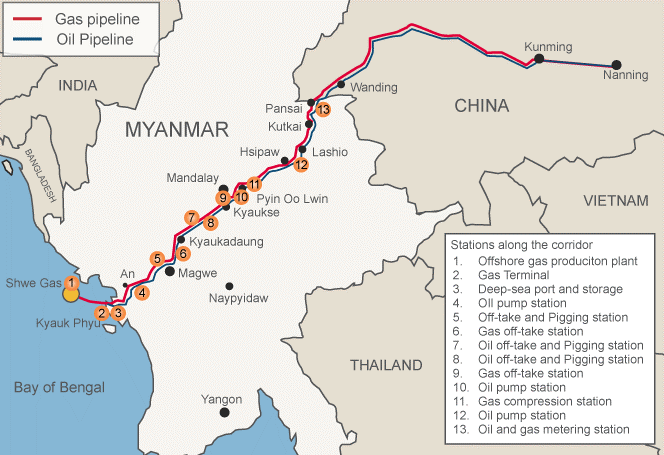
Not surprisingly, China has spent billions of dollars building Myanmar's infrastructure and is currently in the process of building a trans-Myanmar oil and gas pipeline that will connect the Bay of Bengal to Kunming.


The pipeline project, however, is not done yet thanks to resistance from the disgruntled population who resented the project due to the Myanmar government's use of forced labor and land confiscation. To add more headaches, in May, Hsipaw (no. 12 in the map) became the center of fighting between Burmese troops and the rebellious Shan State Army, leading to further delays.

At a glance, this should be the time when the government of Myanmar did it best to minimize its friction with China in order to ensure that the money keeps flowing from Beijing. Thus the news of the cancellation was a surprise and Beijing did not hide its displeasure toward what it saw as a betrayal.

Analyzing what's going on inside Myanmar is a very difficult job, since the government is very secretive, thereby preventing the out-flow of sensitive information. Still, there are a few indicators that might tell us what's going on.

First, it seems that there is growing discontent behind the scene, especially within the military circle, that Myanmar may be too close to China. The fact that there are many serious problems with the dam makes it easy for these dissenters to put the pro-China camp on the spot and claim that the "best" action is simply to cancel the project to maintain the unity of the junta. 

Second, there's also Myanmar's ambition to become the chair of ASEAN in 2014. While the position in essence is ceremonial and ASEAN itself has very limited influence due to its loose grouping, the position can bestow international legitimacy to the regime. Up until now, the ASEAN countries have hesitated in giving Myanmar the position as a chair because they fear a negative reaction from the United States, Japan, and other Western powers, all of which provide a good sum of financial and technical aid to the association.

The dam, in essence, is a good issue to sacrifice. It is unpopular, making ditching it a good idea. It shows that Myanmar is not completely beholden to China, and most importantly, may allow Myanmar to capture the chairmanship of ASEAN that the regime covets.

Saturday, October 1, 2011

On Israel and Palestine: Is Obama Boxed In By Domestic Politics?

Over the last week, I've read what seems like a score of reactions to Obama's pro-Israel U.N. speech. Some--especially, though not exclusively, foreign observers--have expressed surprise, even dismay, at the content of his speech, in light of Obama's initial attempts to play a relatively neutral and even-handed mediator in the Israeli-Palestinian dispute. To these critics, Obama's speech is clear evidence that he has abandoned his overtures to the Palestinians (e.g., his Cairo speech, appointment of a special ambassador for Israel and Palestine, and the public squabbles with Bibi Netanyahu) and is content to let the political and territorial status quo between both sides ride into the foreseeable future. In their view, this development is damaging to the peace process.

For the purposes of this blog post, let's leave aside the impact of Obama's stance on Israeli-Palestinian relations. More interesting, at least to me, is the idea that Obama has turned toward the Netanyahu administration and away from the Palestinian Authority, led by Mahmoud Abbas. Assuming this is indeed true, what's caused the shift in policy?

I saw several interesting lines a recent New York Times article that are relevant to this question:

“The U.S. cannot lead on an issue that it is so boxed in on by its domestic politics,” said Daniel Levy, a former Israeli peace negotiator in the government of Ehud Barak. “And therefore, with the region in such rapid upheaval and the two-state solution dying, as long as the U.S. is paralyzed, others are going to have to step up.”
And following on this point, from same article, here's more:

"Finally, Washington politics has limited Mr. Obama’s ability to try to break the logjam if that means appearing to distance himself from Israel. Republicans have mounted a challenge to lure away Jewish voters who supported Democrats in the past, after some Jewish leaders sharply criticized Mr. Obama for trying to push Israel too hard."
Combined, these two quotes suggest a fairly straightforward and very familiar logic underpinning Obama's pro-Israel U.N. speech. Obama's up for reelection in 2012. Given the wretched state of the American economy, which has adversely impacted Obama's approval numbers, he'll be in for a real struggle come November 2012. Even David Axelrod, a former White House advisor and current Obama campaign strategist, recently admitted that Obama's reelection campaign is in for a "titanic struggle." As a result, Obama's now filtering policy considerations--both domestic and foreign--through the prism of the upcoming elections. One example of this is his strong show of support for Israel at the U.N, for conventional wisdom suggests issues related to that country are crucial to his reelection. According to this logic, Obama must demonstrate to his base of support--specifically, American Jews, a key democratic base of support, and non-Jewish democratic and independent voters--a visceral sense of fidelity to Washington's political, economic, and security ties to Israel, a longstanding friend and ally in an extremely tumultuous region.

It's certainly plausible that electoral concerns played a role in this case, maybe even a big one, but they didn't tie Obama's hands. They didn't determine his seemingly hard shift toward Israel. There's still a sense of agency involved here. After all, he is the president: as the most powerful singular political actor in the world, he has enough freedom to act rather than let himself be overcome by events. Obama could have chosen a different path, a different speech had he felt strongly enough to do so, but he didn't. So let's not operate under the assumption that the words he spoke were out of his control. In the end, what electoral concerns did was to make it more politically costly for Obama to maintain overt sympathies for the Palestinians at the expense of Israel. Should he go that route, pursuing policies consistent with his speeches in 2009, then he runs the risk of alienating a wide swath of voters. But it's up to him to determine whether he wants to make this gamble.

Moreover, in trying to account for what moved Obama to shift toward Israel, keep in mind that there are a host of other possible variables, such as other domestic and international political factors, that could have been in play here. As examples, Obama might be genuinely concerned about the safety of Israel, Iran's future moves, resurgent Arab nationalism, the cohesion of his governing coalition (in a policy rather than electoral sense), and any and all of these (as well as a number of other hypotheticals I haven't mentioned) could have led him to take a more pro-Israel position in his speech than was anticipated.

And don't forget about individual level characteristics and beliefs specific to Obama, such as his policy preferences, political ideology, and whether he's generally risk averse or acceptant. We know from research on political psychology that they are important in leadership decision-making, and it's plausible they were crucial in this situation.

At bottom, some of these individual, domestic, and international level variables might have mattered, some might not. But that's not the point, though. The point is that without a full investigation of the various forces that impinged on Obama, we really don't know what pushed him in one direction over another. My guess is that it's not a monocausal explanation (not just electoral politics, that is), but instead a complex story consisting of multiple consequential causal and intervening variables. Indeed, the social sciences tell us that rarely do we find political events, no matter how large and important or small and trivial, that can be explained by only one observable variable.